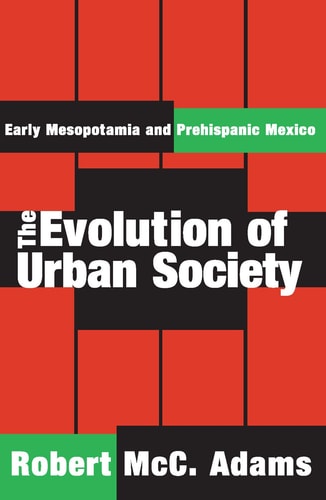
The Evolution of Urban Society: Early Mesopotamia and Prehispanic Mexico
0
0
As an Amazon Associate and affiliate partner, Menrva Books earns from qualifying purchases. Learn more
Author Description
The Evolution of Urban Societyis concerned with the presentation and analysis of regularities in the two best-documented examples of early, independent urban society: Mesopotamia and central Mexico. It provides a systematic comparison of institutional forms and trends of growth that are to be found in both of them. Emphasizing basic similarities in structure rather than the many acknowledged formal features by which each culture is rendered distinguishable from all others, it demonstrates that both societies can usefully be regarded as variants of a single process.Generalizing, comparative analyses of the origins of ancient civilizations in early anthropological studies emphasized the diversity of their cultures rather than their similarities. As this volume illustrates, early societies, in actuality, provide a significant example of broad regularities in human behavior. The emergence of states - of stratified, politically organized societies based upon a complex division of labor - is one of those great transformations that have punctuated human civilization. Adams shows why the study of societal evolution is so significant, and why it has remained a durable and attractive anthropological focus of interest.Originally published in 1966, The Evolution of Urban Society is based on a series of lectures at the University of Rochester in honor of the esteemed anthropologist Lewis Henry Morgan. It remains required reading for students of anthropology, ethnography, ancient civilizations, and world history. As Elizabeth Carter noted in Science at the time: "Adams's The Evolution of Urban Society set the agenda for contemporary research into early urbanism in the [Mesopotamian] region."
Menrva's Summary
THE THESIS
This work investigates the underlying regularities in the development of early urban societies by comparing the historical trajectories of Mesopotamia and prehispanic Mexico. Robert McC. Adams, a distinguished anthropologist, utilizes a comparative framework to analyze how stratified, politically organized states emerged from complex divisions of labor. By focusing on structural similarities rather than cultural idiosyncrasies, the author argues that these disparate civilizations represent variants of a singular evolutionary process in human history.
THE SCOPE MAP
What You Will Find
- Comparative analysis of institutional growth in Mesopotamia and central Mexico
- Theoretical framework for the emergence of stratified, state-level societies
- Examination of economic and political shifts during the transition to urbanism
- Synthesis of archaeological data and anthropological theory regarding societal evolution
THE AUTHORITY PERSPECTIVE
Experts recognize this text as a foundational contribution to the study of early urbanism and comparative archaeology. Scholars frequently cite the work for its influence on contemporary research methodologies regarding the origins of ancient civilizations.
Page Count:
204
Publication Date:
2005-06-30
Publisher:
Routledge
ISBN-10:
0202308189
ISBN-13:
9780202308180
History
Anthropology
Sociology
Iraq
Cities And Towns
Ethnology_iraq
Archaeology
Indians of Mexico