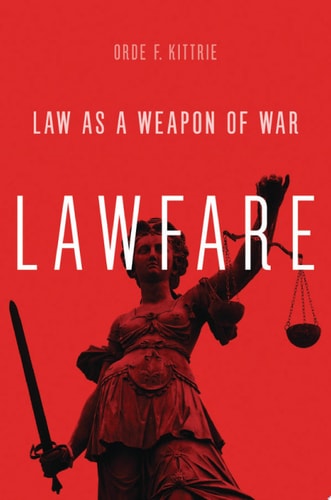
Lawfare: Law as a Weapon of War
0
0
As an Amazon Associate and affiliate partner, Menrva Books earns from qualifying purchases. Learn more
Author Description
International military interventions endanger soldier and civilian lives, can be financially costly, and risk spiraling out of control. One incident which exemplified the risks involved a US and UK wish to stop a Russian ship from delivering helicopter gunships to the Assad regime in Syria in 2012. Forcibly intercepting a Russian ship in transit could have risked World War III, so they developed an alternative, non-confrontational maneuver: instead of military intervention, the UK persuaded the ship's insurer, London's Standard Club, to withdraw the ship's insurance. This loss of insurance caused the ship to return to Russia, thus avoiding an international clash as well as the delivery of deadly weapons to Syria. This use of legal maneuvering in lieu of armed force is known as "lawfare" and is becoming a critical tool in the foreign policy arena. In Lawfare, author Orde Kittrie draws on his experiences as a lawfare practitioner, US State Department attorney, and international law scholar in analyzing the theory and practice of lawfare. Kittrie explains how factors including the increased reach of international laws and tribunals and the rise of economic globalization and information technology have fueled lawfare's increasing power and prevalence. The book includes case studies of recent offensive and defensive lawfare by the United States, China, all sides of the Israeli-Palestinian conflict, and several non-governmental organizations and individuals. Kittrie asserts that much of the United States' most effective and creative lawfare today is being waged by private sector or other non-governmental attorneys. He analyzes why this is the case, and describes how such attorneys' expertise and experience can contribute even more to U.S. national security. Kittrie also explains that lawfare, deployed more systematically and adeptly by the U.S. government, could likely reduce U.S. and foreign casualties, and save U.S. taxpayer dollars, by supplementing or replacing the us
Menrva's Summary
THE THESIS
This book investigates how legal maneuvering, or 'lawfare,' functions as a strategic alternative to traditional military force in international conflicts. Author Orde F. Kittrie, a former U.S. State Department attorney and international law scholar, utilizes his professional background to construct a framework for understanding how legal tools are deployed to achieve national security objectives. He argues that the expansion of international law and economic globalization has elevated the efficacy of non-kinetic interventions, proposing that systematic integration of these methods could reduce casualties and costs for the United States.
THE SCOPE MAP
What You Will Find
- Analysis of the intersection between international law, economic sanctions, and military strategy.
- Case studies involving the United States, China, and the Israeli-Palestinian conflict.
- Examination of the role of private sector and non-governmental attorneys in national security operations.
- Theoretical framework for offensive and defensive lawfare applications.
Scope Limits
- The text focuses primarily on the strategic utility of lawfare rather than an exhaustive history of international legal institutions.
- It does not provide a comprehensive legal manual for practitioners but rather a policy-oriented analysis of statecraft.
THE AUTHORITY PERSPECTIVE
Experts and policy analysts frequently cite this work as a foundational text for understanding the modern evolution of non-kinetic warfare. Readers often note the academic rigor of the prose, which balances detailed legal analysis with accessible strategic theory for both practitioners and students of international relations.
Page Count:
501
Publication Date:
2015-01-01
Publisher:
Oxford University Press
ISBN-10:
0190263598
ISBN-13:
9780190263591
National security
Military Strategy
Professional Career & Trade
Foreign Policy
International Law
Community Tags
Similar Books