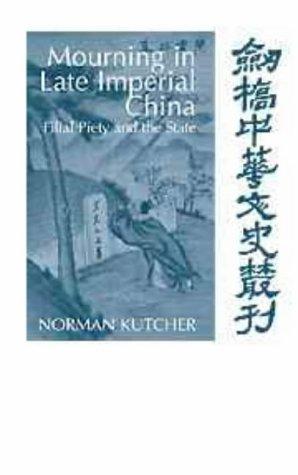
Mourning in Late Imperial China
0
0
As an Amazon Associate and affiliate partner, Menrva Books earns from qualifying purchases. Learn more
Author Description
The new Manchu rulers of Qing Dynasty China (1644-1912), as the conquering regime, desperately needed to legitimize their rule. To win the approval of China's native elites, they developed an ambitious plan to return Confucianism to civil society. Filial piety, the core Confucian value, would once again be upheld by the state, and officials throughout the empire would observe the laborious and time-consuming mourning rituals that were the touchstone of a well-ordered Confucian society. In this way, the emperor would be following the ancient dictate that he "govern all under heaven with filial piety." Norman Kutcher's pioneering study of mourning in late Imperial China looks beneath the rhetoric to demonstrate how the state - unwilling to make the sacrifices that a genuine commitment to proper mourning demanded - quietly but forcefully undermined, rather than reinvigorated, the Confucian mourning system. This book will interest not only those concerned with late Imperial China, but anyone seeking to understand the role of ritual and filial piety in Chinese society.
Menrva's Summary
THE THESIS
The Qing Dynasty sought to legitimize its rule by reviving Confucian mourning rituals, but ultimately undermined the very system it promoted. The Manchu rulers of China (1644-1912) aimed to win over native elites by re-emphasizing filial piety and its associated elaborate mourning rites. However, as Norman Kutcher demonstrates, the state's reluctance to fully commit to these demanding rituals led to their quiet but forceful subversion, rather than their intended revitalization. This study examines the complex interplay between state policy, social elites, and ritual practice in late imperial China.
THE SCOPE MAP
- Analysis of the Qing Dynasty's strategy to legitimize rule through Confucianism.
- Detailed examination of filial piety and its role in state-sponsored mourning rituals.
- Exploration of the conflict between state rhetoric and the practical implementation of mourning practices.
- Investigation into how the state's actions undermined, rather than reinforced, the Confucian mourning system.
- Discussion of the implications for understanding ritual and social order in Chinese society.
- Focus on the period of late Imperial China (1644-1912).
THE AUTHORITY PERSPECTIVE
This scholarly work is recognized for its in-depth analysis of ritual and social policy in late imperial China. The book's examination of the Qing Dynasty's efforts to legitimize its rule through Confucian mourning rituals offers a nuanced perspective on the period. It highlights the tension between state ideals and practical implementation, revealing how the very system intended to reinforce social order was, in fact, subtly undermined. The study is valuable for those interested in Chinese history, Confucianism, and the sociology of ritual.
Page Count:
210
Publication Date:
1999-01-01
ISBN-10:
0521624398
Non-Fiction
History
Confucianism
Chinese History
Ritual Studies
Social History
Community Tags
Similar Books