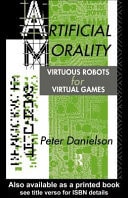
Artificial Morality: Virtuous Robots for Virtual Games
0
0
As an Amazon Associate and affiliate partner, Menrva Books earns from qualifying purchases. Learn more
Author Description
This book explores the role of artificial intelligence in the development of a claim that morality is person-made and rational. Professor Danielson builds moral robots that do better than amoral competitors in a tournament of games like the Prisoners Dilemma and Chicken. The book thus engages in current controversies over the adequacy of the received theory of rational choice. It sides with Gauthier and McClennan, who extend the devices of rational choice to include moral constraint. Artificial Morality goes further, by promoting communication, testing and copying of principles and by stressing empirical tests.
Menrva's Summary
THE THESIS
This book investigates whether morality can be constructed as a rational, person-made system through the development of artificial intelligence. Professor Peter A. Danielson utilizes his background in philosophy and rational choice theory to argue that moral constraints can be integrated into computational models. By building moral robots to compete in classic game theory scenarios, he challenges traditional views on rational choice and proposes a framework centered on communication, empirical testing, and the replication of moral principles.
THE SCOPE MAP
What You Will Find
- Analysis of game theory models including the Prisoners Dilemma and Chicken
- A computational framework for testing moral constraints in artificial agents
- Empirical evaluation of moral versus amoral decision-making strategies
- Theoretical synthesis of Gauthier and McClennan’s rational choice models
THE AUTHORITY PERSPECTIVE
Experts recognize this work as a significant contribution to the intersection of computational ethics and rational choice theory. Readers frequently note the technical density of the prose, which requires a foundational understanding of game theory to fully grasp the author's arguments.
Page Count:
256
Publication Date:
2002-01-01
Publisher:
Taylor & Francis Group
ISBN-10:
0203022343
ISBN-13:
9780203022344
Philosophy
Ethics
Game theory
Computer Science
Community Tags
Similar Books