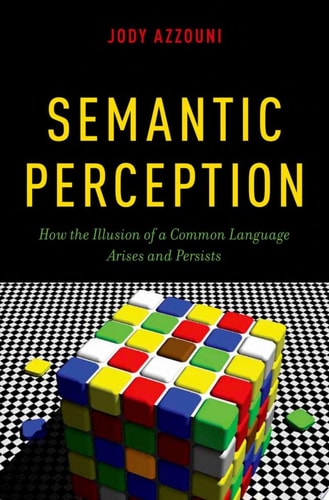
Semantic Perception: How the Illusion of a Common Language Arises and Persists
0
0
As an Amazon Associate and affiliate partner, Menrva Books earns from qualifying purchases. Learn more
Author Description
Jody Azzouni argues that we involuntarily experience certain physical items, certain products of human actions, and certain human actions themselves as having meaning-properties. We understand these items as possessing meaning or as having (or being capable of having) truth values. For example, a sign on a door reading "Drinks Inside" strikes native English speakers as referring to liquids in the room behind the door. The sign has a truth value--if no drinks are found in the room, the sign is misleading. Someone pointing in a direction has the same effect: we experience her gesture as significant. Azzouni does not suggest that we don't recognize the expectations or intentions of speakers (including ourselves); we do recognize that the person pointing in a certain direction intends for us to understand her gesture's significance. Nevertheless, Azzouni asserts that we experience that gesture as having significance independent of her intentions. The gesture is meaningful on its own. The same is true of language, both spoken and written. We experience the meanings of language artifacts as independent of their makers' intentions in the same way that we experience an object's shape as a property independent of the object's color. There is a distinctive phenomenology to the experience of understanding language, and Semantic Perception shows how this phenomenology can be brought to bear as evidence for and against competing theories of language.
Menrva's Summary
THE THESIS
This book investigates the core question of how human beings experience linguistic and symbolic artifacts as possessing inherent meaning independent of the intentions of their creators. Jody Azzouni, a philosopher known for his work in nominalism and the philosophy of mathematics, utilizes a framework rooted in phenomenology to argue that our perception of meaning is an involuntary cognitive response. He posits that we perceive semantic properties—such as truth values or referential content—as objective features of the world, similar to how we perceive physical properties like shape or color.
THE SCOPE MAP
What You Will Find
- An analysis of the phenomenology of linguistic understanding.
- A critique of intentionalist theories of meaning.
- Arguments regarding the independence of semantic properties from speaker intent.
- Case studies involving signs, gestures, and written language.
Scope Limits
- The text does not provide a comprehensive history of linguistic theory.
- It does not focus on the sociological or cultural evolution of specific languages.
THE AUTHORITY PERSPECTIVE
Scholars in the philosophy of language frequently note the technical density of Azzouni's prose, which requires a strong background in analytic philosophy to navigate effectively. Experts highlight this work as a significant contribution to the debate between internalist and externalist accounts of semantic perception.
Page Count:
386
Publication Date:
2015-10-01
Publisher:
Oxford University Press
ISBN-10:
0190275545
ISBN-13:
9780190275549
Philosophy
Philosophy of
Epistemology
Linguistics
Community Tags
Similar Books