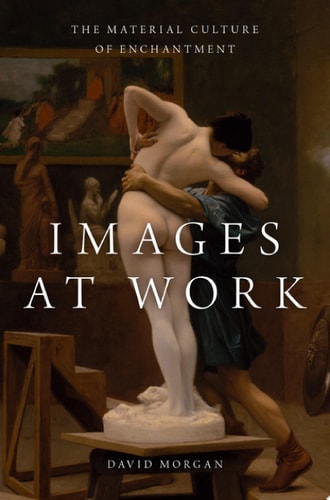
Images at Work: The Material Culture of Enchantment
0
0
As an Amazon Associate and affiliate partner, Menrva Books earns from qualifying purchases. Learn more
Author Description
Images can be studied in many ways--as symbols, displays of artistic genius, adjuncts to texts, or naturally occurring phenomena like reflections and dreams. Each of these approaches is justified by the nature of the image in question as well as the way viewers engage with it. But images are often something more when they perform in ways that exhibit a capacity to act independent of human will. Images come alive--they move us to action, calm us, reveal the power of the divine, change the world around us. In these instances, we need an alternative model for exploring what is at work, one that recognizes the presence of images as objects that act on us. Building on his previous innovative work in visual and religious studies, David Morgan creates a new framework for understanding how the human mind can be enchanted by images in Images at Work. In carefully crafted arguments, Morgan proposes that images are special kinds of objects, fashioned and recognized by human beings for their capacity to engage us. From there, he demonstrates that enchantment, as described, is not a violation of cosmic order, but a very natural way that the mind animates the world around it. His groundbreaking study outlines the deeply embodied process by which humans create culture by endowing places, things, and images with power and agency. These various agents--human and non-human, material, geographic, and spiritual--become nodes in the web of relationships, thus giving meaning to images and to human life. Marrying network theory with cutting-edge work in visual studies, and connecting the visual and bodily technologies employed by the ancient Greeks and Romans to secular icons like Che Guevara, Abraham Lincoln, and Mao, Images at Work will be transformative for those curious about why images seem to have a power of us in ways we can't always describe.
Menrva's Summary
THE THESIS
This book investigates the mechanisms by which images function as active agents that exert influence over human perception and behavior. David Morgan, a scholar of visual and religious studies, constructs a framework that treats images as material objects endowed with agency. By integrating network theory with historical and contemporary visual analysis, he argues that the human capacity for enchantment is a cognitive process that animates the material world.
THE SCOPE MAP
What You Will Find
- A theoretical framework for understanding images as active agents rather than passive symbols.
- Analysis of visual and bodily technologies spanning from ancient Greek and Roman practices to modern secular icons.
- Application of network theory to explain how material objects, geographic locations, and spiritual concepts interact.
Scope Limits
- The text does not provide a comprehensive history of art, focusing instead on the functional agency of specific images.
- It does not offer a psychological diagnosis of belief, but rather a sociological and materialist account of cultural production.
THE AUTHORITY PERSPECTIVE
Scholars in visual culture and religious studies identify this work as a significant contribution to the study of material agency. Readers frequently note the academic density of the prose, which requires familiarity with contemporary social theory to fully synthesize the author's arguments.
Page Count:
234
Publication Date:
2018-01-01
Publisher:
Oxford University Press
ISBN-10:
0190272139
ISBN-13:
9780190272135
Graphic ArtsCommunicationsDesign
Humanities
Visual Culture
Art History
Professional Career & Trade
Media Studies
Sociology
Art Criticism
Subjects & Themes
Community Tags
Similar Books