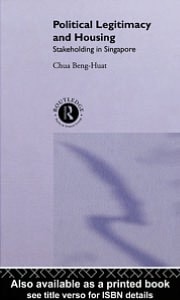
Political Legitimacy and Housing: Singapore's Stakeholder Society
0
0
As an Amazon Associate and affiliate partner, Menrva Books earns from qualifying purchases. Learn more
Author Description
Singapore's successful public housing programme is a source of political legitimacy for the ruling People's Action Party. Beng-Huat Chua accounts for the success of public housing in Singapore and draws out lessons for other nations. Housing in Singapore, he explains in this incisive analysis, is seen neither as a consumer good (as in the US) nor as a social right (as in the social democracies of Europe). The author goes on to look at the ways in which Singapore's planners have dealt with the problems of creating communities in a modern urban environment. He concludes that the success of the public housing programme has done much for Singapore.
Menrva's Summary
THE THESIS
This book investigates how Singapore's public housing program functions as a primary mechanism for establishing and maintaining political legitimacy for the ruling People's Action Party. Beng-Huat Chua, a prominent sociologist, examines the unique intersection of state-led urban development and social stability. He argues that Singapore's model rejects both the market-driven approach of the United States and the social-right framework of European social democracies, opting instead for a stakeholder-based system. The text provides a critical analysis of how housing policy is leveraged to integrate citizens into the state's broader political and economic objectives.
THE SCOPE MAP
What You Will Find
- An analysis of the Housing and Development Board (HDB) as a tool for state governance.
- A comparative framework contrasting Singapore's housing model with Western market and social democratic systems.
- Case studies on the social engineering of community life within high-density urban environments.
- An evaluation of the long-term political consequences of homeownership policies on voter behavior.
THE AUTHORITY PERSPECTIVE
Reader & Expert Consensus: Scholars and urban planners frequently cite this work as a foundational text for understanding the specific socio-political landscape of Singapore. Experts highlight the author's ability to synthesize complex policy data into a clear argument regarding the relationship between state legitimacy and urban infrastructure.
Page Count:
0
Publication Date:
2002-01-01
Publisher:
Taylor & Francis Group
ISBN-10:
0203076184
ISBN-13:
9780203076187
City Planning
urban planning
Sociology
Public Housing
Public Policy
Community Tags
Similar Books