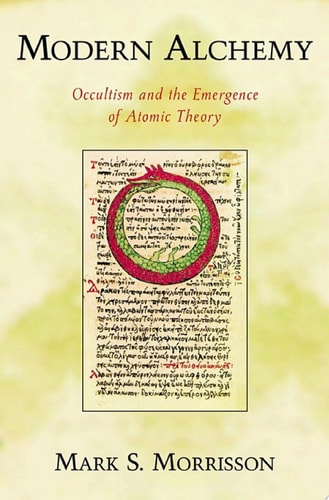
Modern Alchemy: Occultism and the Emergence of Atomic Theory
0
0
As an Amazon Associate and affiliate partner, Menrva Books earns from qualifying purchases. Learn more
Author Description
Alchemists are generally held to be the quirky forefathers of science, blending occultism with metaphysical pursuits. Although many were intelligent and well-intentioned thinkers, the oft-cited goals of alchemy paint these antiquated experiments as wizardry, not scientific investigation. Whether seeking to produce a miraculous panacea or struggling to transmute lead into gold, the alchemists radical goals held little relevance to consequent scientific pursuits. Thus, the temptation is to view the transition from alchemy to modern science as one that discarded fantastic ideas about philosophers stones and magic potions in exchange for modest yet steady results. It has been less noted, however, that the birth of atomic science actually coincided with an efflorescence of occultism and esoteric religion that attached deep significance to questions about the nature of matter and energy. Mark Morrisson challenges the widespread dismissal of alchemy as a largely insignificant historical footnote to science by prying into the revival of alchemy and its influence on the emerging subatomic sciences of the late 19th and early 20th centuries.Morrisson demonstrates its surprising influence on the emerging subatomic sciences of the late 19th and early 20th centuries. Specifically, Morrisson examines the resurfacing of occult circles during this time period and how their interest in alchemical tropes had a substantial and traceable impact upon the science of the day. Modern Alchemy chronicles several encounters between occult conceptions of alchemy and the new science, describing how academic chemists, inspired by the alchemy revival, attempted to transmute the elements; to make gold. Examining scientists publications, correspondence, talks, and laboratory notebooks as well as the writings of occultists, alchemical tomes, and science-fiction stories, he argues that during the birth of modern nuclear physics, the trajectories of science and occultism---so often considered antitheti
Menrva's Summary
THE THESIS
Does the history of modern atomic theory contain a hidden, significant influence from the late 19th-century revival of occultism and alchemical thought? Mark Morrisson, a scholar of literature and science, investigates the intersection of esoteric belief systems and the birth of nuclear physics. By analyzing the correspondence, laboratory notes, and public discourse of early atomic scientists, he argues that the development of modern science was not a clean break from alchemy, but rather a period where occult tropes and scientific inquiry were deeply intertwined.
THE SCOPE MAP
What You Will Find
- Analysis of the late 19th and early 20th-century occult revival
- Examination of attempts by academic chemists to achieve elemental transmutation
- Comparative study of scientific publications alongside occult texts and science fiction
Scope Limits
- The text focuses primarily on the Western scientific and occult traditions of the specified era
- It does not provide a comprehensive history of alchemy from antiquity to the present
THE AUTHORITY PERSPECTIVE
Scholars and historians of science frequently note the book's success in challenging the traditional narrative of a binary opposition between early physics and occultism. Experts highlight this as a significant contribution to understanding the cultural context of the scientific revolution in the early 20th century.
Page Count:
272
Publication Date:
2007-01-01
Publisher:
Oxford University Press
ISBN-10:
0190294493
ISBN-13:
9780190294496
Occultism
Alchemy
Physics
Body Mind Spirit
Science History
Intellectual History
Community Tags
Similar Books