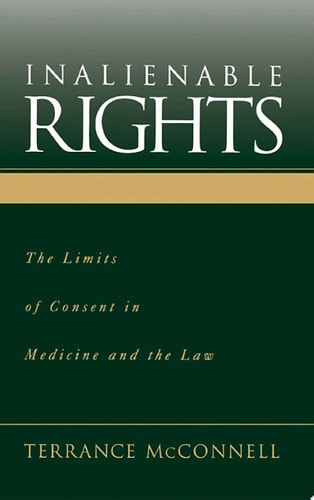
Inalienable Rights: The Limits of Consent in Medicine and the Law
0
0
As an Amazon Associate and affiliate partner, Menrva Books earns from qualifying purchases. Learn more
Author Description
This book explains what inalienable rights are and how they restrict the behavior of their possessors. McConnell develops compelling arguments to support the inalienability of the right to life, the right of conscience, and a competent person's right not to have medical treatment administered without consent. Yet, surprisingly, he argues that the inalienability of the right to life does not entail that voluntary euthanasia or assisted suicide are wrong. This distinctive defense of inalienable rights will appeal to medical ethicists and other applied ethicists, political theorists, and philosophers of law.
Menrva's Summary
THE THESIS
This book investigates the conceptual boundaries of inalienable rights and how these rights constrain the actions of the individuals who possess them. Terrance McConnell, a scholar in moral and political philosophy, utilizes a rigorous analytical framework to examine the intersection of personal autonomy and legal obligation. He evaluates the moral status of specific rights, arguing that while certain rights are inherently inalienable, their existence does not necessarily prohibit specific medical practices such as voluntary euthanasia or assisted suicide.
THE SCOPE MAP
What You Will Find
- A philosophical analysis of the right to life and the right of conscience
- A legal and ethical framework regarding informed consent in medical treatment
- Arguments concerning the logical consistency of inalienable rights
Scope Limits
- The text does not provide a comprehensive survey of global legal statutes regarding euthanasia
- It does not focus on the clinical procedures of end-of-life care
THE AUTHORITY PERSPECTIVE
Experts in bioethics and legal philosophy identify this work as a significant contribution to the discourse on individual autonomy. Readers frequently note the academic density of the prose, which is tailored for scholars and practitioners in applied ethics.
Page Count:
184
Publication Date:
2000-01-01
Publisher:
Oxford University Press
ISBN-10:
0190285478
ISBN-13:
9780190285470
Philosophy
Law
Natural law
Bioethics
Political Theory
Medical
Consent law
Medical Ethics
Allied Health
Community Tags
Similar Books