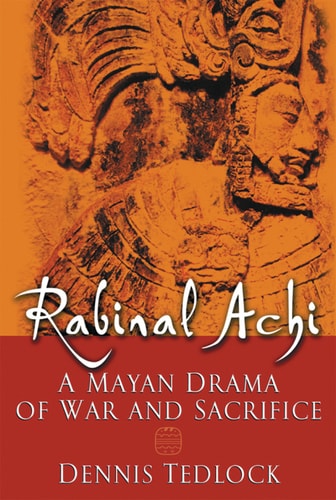
Rabinal Achi: A Mayan Drama of War and Sacrifice
0
0
As an Amazon Associate and affiliate partner, Menrva Books earns from qualifying purchases. Learn more
Author Description
Here is one of the most important surviving works of pre-Columbian civilization, Rabinal Achi, a Mayan drama set a century before the arrival of the Spanish, produced by the translator of the best selling Popol Vuh. The first direct translation into English from Quiché Maya, based on the original text, Rabinal Achi is the story of city-states, war, and nobility, of diplomacy, mysticism, and psychic journeys. Cawek of the Forest People has been captured by Man of Rabinal, who serves a ruler named Lord Five Thunder. Cawek is a renegade, a warrior who has inflicted much suffering on Rabinal. Yet he is also the son of the lord of the allied city of Quiché--a noble who once fought alongside Man of Rabinal. The drama presents the confrontation between the two during the trial of Cawek, who defies his captors and proudly accepts death by beheading. Dennis Tedlock's translation is clear and vivid; more than that, it is rooted in an understanding of how the play is actually performed. Despite being banned for centuries by Spanish authorities, it survived in actual practice, and is still performed in the town of Rabinal today. Tedlock's photographs and diagrams accompany the text, capturing nuances not apparent in the dialogue alone. He also provides an introduction and commentary that explain the historical events compressed into the play, the Spanish influence on the Mayan dramatic tradition, and the cultural and religious world preserved in this remarkable play. Rabinal Achi ranks as a classic of Mayan literature--and a rare window on a world that had yet to be invaded by Europeans. Dennis Tedlock brings this drama to life in all its richness.
Menrva's Summary
THE PULSE
The central conflict arises when the warrior Cawek of the Forest People is captured by the forces of the city-state of Rabinal, leading to a high-stakes trial that tests the boundaries of nobility, loyalty, and fate. The narrative follows the confrontation between the captive Cawek and his captor, the Man of Rabinal, who serves the ruler Lord Five Thunder. As a renegade who has caused significant suffering, Cawek faces a trial that serves as a crucible for his identity and his status as a noble son of the Quiché. The drama unfolds through a series of intense dialogues and ritualized exchanges that emphasize the inevitability of his execution. The work functions as a theatrical performance piece, rooted in the oral and performative traditions of the Mayan people.
INSIDE THE PAGES
- Traditional Mayan dramatic structure
- Ritualized dialogue and oratorical performance
- Themes of political diplomacy and warfare
- Exploration of noble duty and sacrifice
- Incorporation of mystical and spiritual elements
- Historical context of pre-Columbian city-states
- Analysis of performative nuances and staging
- Inclusion of photographs and diagrams for visual context
THE COLLECTIVE ECHO
Readers and critics frequently highlight the significance of this work as a rare, authentic window into pre-Columbian Mayan culture. Discussion often centers on the tension between the play's rigid, formal structure and the raw, defiant nature of the protagonist's final moments. Scholars appreciate the translator's commitment to capturing the performative aspects of the text, which elevates it beyond a mere written script. Many note that the inclusion of historical commentary provides necessary depth for understanding the complex political landscape of the era. The work is widely regarded as a vital contribution to the study of indigenous dramatic traditions.
Page Count:
371
Publication Date:
2003-01-01
Publisher:
Oxford University Press
ISBN-10:
0190286164
ISBN-13:
9780190286163
History
Drama
English
Cultural Anthropology
Humanities
Mythology
Mayan
Special Topics
Theatre
American History
Dramatic works
English & College Success
Drama
Community Tags
Similar Books