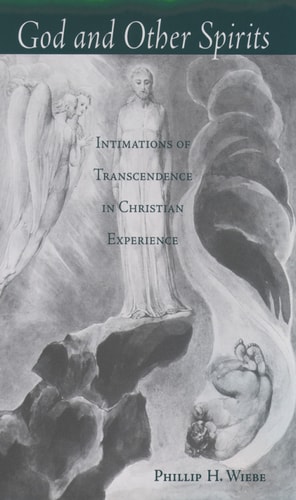
God and Other Spirits: Intimations of Transcendence in Christian Experience
0
0
As an Amazon Associate and affiliate partner, Menrva Books earns from qualifying purchases. Learn more
Author Description
Many people believe in angels and evil spirits, and popular culture abounds in talk about encounters with such entities. Yet the question of the existence of such spirits is ignored in the academy. Even the Christian Church, which one might expect to show keen interest in transcendent realities, does not appear to be paying much attention. In this book Phillip Wiebe defends the plausibility of the traditional Christian claim that spirits are real. Wiebe examines descriptions of encounters with both good and evil transcendent beings in biblical times and in later Christian history, along with recent accounts of similar experiences. He argues that invisible beings can be postulated to explain events just as unobservable objects are postulated in many scientific theories. Beyond supporting claims for the existence of lesser spirits such as demons and angels, this empirical approach yields important results for assessing common arguments surrounding the existence of God - a question that has become artificially separated from the question of spirits as such. Grounding his argument in a wide range of phenomena - from near death experiences to demonic possession - Wiebe offers a sophisticated case for belief in God on philosophical and epistemological grounds.
Menrva's Summary
THE THESIS
This book investigates whether the existence of transcendent spirits and God can be defended as a rational, empirical hypothesis within the context of Christian experience. Phillip H. Wiebe, a scholar of philosophy and religion, utilizes a comparative analysis of historical and contemporary accounts of spiritual encounters to challenge the academic neglect of this subject. He argues that the existence of invisible entities can be treated as a legitimate explanatory postulate, mirroring the way unobservable objects are utilized in scientific theory to account for observed phenomena.
THE SCOPE MAP
What You Will Find
- Comparative analysis of biblical, historical, and modern accounts of spiritual encounters
- Philosophical framework for treating spiritual entities as explanatory hypotheses
- Examination of near death experiences and reports of demonic possession
- Epistemological arguments linking the existence of lesser spirits to the existence of God
Scope Limits
- The text does not provide a comprehensive sociological survey of global spiritual beliefs
- The work does not attempt to prove the existence of God through traditional ontological or cosmological arguments alone
THE AUTHORITY PERSPECTIVE
Scholars and readers often note the academic rigor and philosophical density of Wiebe's prose, which bridges the gap between theology and analytic philosophy. Experts frequently highlight this work as a significant contribution to the field of religious epistemology for its willingness to engage with empirical claims regarding the supernatural.
Page Count:
263
Publication Date:
2004-01-01
Publisher:
Oxford University Press
ISBN-10:
0190286202
ISBN-13:
9780190286200
Spirituality
Philosophy
Religion
Epistemology
Theology
Apologetics
Philosophy of
Christian Theology
Community Tags
Similar Books