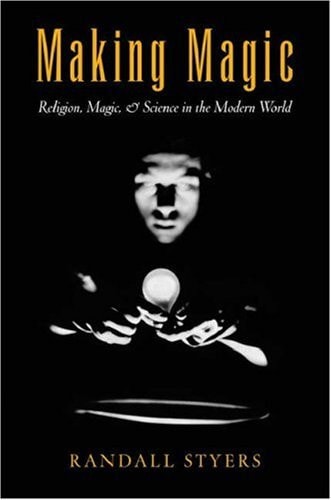
Making Magic: Religion, Magic, and Science in the Modern World
0
0
As an Amazon Associate and affiliate partner, Menrva Books earns from qualifying purchases. Learn more
Author Description
Since the emergence of religious studies and the social sciences as academic disciplines, the concept of "magic" has played a major role in defining religion and in mediating the relation of religion to science. Across these disciplines, magic has regularly been configured as a definitively non-modern phenomenon, juxtaposed to distinctly modern models of religion and science. Yet this notion of magic has remained stubbornly amorphous. In Making Magic, Randall Styers seeks to account for the extraordinary vitality of scholarly discourse purporting to define and explain magic despite its failure to do just that. He argues that this persistence can best be explained in light of the Western drive to establish and secure distinctive norms for modern identity, norms based on narrow forms of instrumental rationality, industrious labor, rigidly defined sexual roles, and the containment of wayward forms of desire. Magic has served to designate a form of alterity or deviance against which dominant Western notions of appropriate religious piety, legitimate scientific rationality, and orderly social relations are brought into relief. Scholars have found magic an invaluable tool in their efforts to define the appropriate boundaries of religion and science. On a broader level, says Styers, magical thinking has served as an important foil for modernity itself. Debates over the nature of magic have offered a particularly rich site at which scholars have worked to define and to contest the nature of modernity and norms for life in the modern world.
Menrva's Summary
THE THESIS
This book investigates how the academic construction of 'magic' has functioned as a critical tool for defining the boundaries of religion, science, and modern Western identity. Randall Styers, a scholar of religious studies, examines the historical and intellectual development of the concept of magic within the social sciences. He argues that the persistent, often contradictory definitions of magic are not merely descriptive failures but are instead strategic maneuvers used to establish norms for modern rationality, labor, and social behavior. By positioning magic as an 'other' or a deviant practice, scholars have historically reinforced the perceived legitimacy of Western scientific and religious frameworks.
THE SCOPE MAP
What You Will Find
- Historical analysis of the emergence of religious studies and social sciences.
- Theoretical framework linking the concept of magic to Western modernity.
- Examination of how magic serves as a foil for defining appropriate religious piety and scientific rationality.
Scope Limits
- The text does not provide a comprehensive history of magical practices themselves, focusing instead on the academic discourse surrounding the term.
- It does not offer a universal definition of magic, but rather critiques the scholarly attempts to create one.
THE AUTHORITY PERSPECTIVE
Scholars in the field of religious studies frequently cite this work as a foundational text for understanding the intellectual history of the 'magic' category. Readers often note the academic density of the prose, which requires a strong background in social theory to fully navigate the author's arguments.
Page Count:
298
Publication Date:
2004-01-01
Publisher:
Oxford University Press
ISBN-10:
0190287926
ISBN-13:
9780190287924
Religion
Philosophy
Science History
Magic
Cultural Anthropology
Academic
Sociology
Community Tags
Other Editions(3)

Similar Books

Reader Comments
Share Your Thoughts
No comments yet. Be the first to share your thoughts!