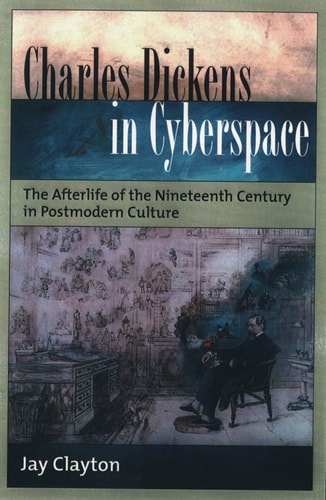
Charles Dickens in Cyberspace: The Afterlife of the Nineteenth Century in Postmodern Culture
0
0
As an Amazon Associate and affiliate partner, Menrva Books earns from qualifying purchases. Learn more
Author Description
Charles Dickens in Cyberspace opens a window on a startling set of literary and scientific links between contemporary American culture and the nineteenth-century heritage it often repudiates. Surveying a wide range of novelists, scientists, filmmakers, and theorists from the past two centuries, Jay Clayton traces the concealed circuits that connect the telegraph with the Internet, Charles Babbage's Difference Engine with the digital computer, Frankenstein's monster with cyborgs and clones, and Dickens' life and fiction with all manner of contemporary popular culture--from comic books and advertising to recent novels and films. In the process, Clayton argues for two important principles: that postmodernism has a hidden or repressed connection with the nineteenth-century and that revealing those connections can aid in the development of a historical cultural studies. In Charles Dickens in Cyberspace nineteenth-century figures--Jane Austen, Charles Darwin, Charles Dickens, Thomas Hardy, Henry James, Ada Lovelace, Joseph Paxton, Mary Shelley, and Mary Somerville--meet a lively group of counterparts from today: Andrea Barrett, Greg Bear, Peter Carey, Hélène Cixous, Alfonso Cuarón, William Gibson, Donna Haraway, David Lean, Richard Powers, Salman Rushdie, Ridley Scott, Susan Sontag, Neal Stephenson, Bruce Sterling, and Tom Stoppard. The juxtaposition of such a diverse cast of characters leads to a new way of understanding the "undisciplined culture" the two eras share, an understanding that can suggest ways to heal the gap that has long separated literature from science. Combining storytelling and scholarship, this engaging study demonstrates in its own practice the value of a self-reflective stance toward cultural history. Its personal voice, narrative strategies, multiple points of view, recursive loops, and irony emphasize the improvisational nature of the methods it employs. Yet its argument is serious and urgent: that the afterlife of the nineteenth century continues
Menrva's Summary
THE THESIS
How do the technological and cultural developments of the nineteenth century continue to shape and inform the digital landscape of postmodern society? Jay Clayton, a professor of English, utilizes a multidisciplinary framework to examine the persistent influence of Victorian-era figures and inventions on contemporary media, literature, and scientific discourse. He argues that postmodernism maintains a repressed, yet vital, link to the nineteenth century, and that acknowledging these connections is necessary for a more robust understanding of modern cultural history.
THE SCOPE MAP
What You Will Find
- Comparative analysis of nineteenth-century technologies like the telegraph and the Difference Engine alongside modern digital computing and the Internet.
- Examination of literary archetypes, such as Frankenstein's monster, in relation to modern concepts of cyborgs and clones.
- A diverse cast of historical and contemporary figures, including Charles Dickens, Ada Lovelace, William Gibson, and Donna Haraway.
- Methodologies that blend traditional academic scholarship with narrative-driven, self-reflective cultural analysis.
Scope Limits
- The text does not provide an exhaustive history of either the nineteenth century or the postmodern era.
- It focuses primarily on American and British cultural intersections rather than a global survey of technological development.
THE AUTHORITY PERSPECTIVE
Scholars and critics frequently note the book's innovative approach to bridging the divide between literary studies and the history of science. Experts highlight this as a significant contribution to cultural studies for its ability to synthesize disparate historical periods into a cohesive argument about technological continuity.
Page Count:
280
Publication Date:
2003-01-01
Publisher:
Oxford University Press
ISBN-10:
0190289600
ISBN-13:
9780190289607
Postmodernism
United States
English & College Success
English
Victorian
Science History
Media Studies
Literary Criticism
Community Tags
Similar Books