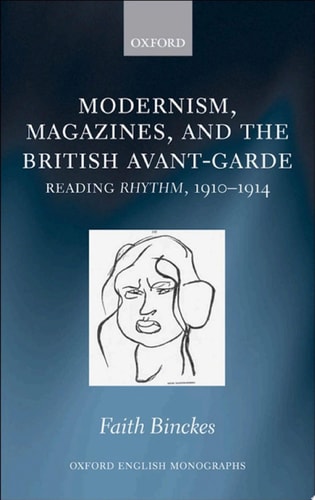
Modernism, Magazines, and the British Avant-Garde: Reading Rhythm, 1910-1914
0
0
As an Amazon Associate and affiliate partner, Menrva Books earns from qualifying purchases. Learn more
Author Description
This book is a re-examination of the fertile years of early modernism immediately preceding the First World War. During this period, how, where, and under whose terms the avant-garde in Britain would be constructed and consumed were very much to play for. It is the first study to look in detail at two little magazines marginalised from many accounts of this competitive process: Rhythm and the Blue Review. By thoroughly examining not only the content but the interrelated networks that defined and surrounded these publications, Faith Binckes aims to provide a fresh and challenging perspective to the on-going reappraisal of modernism. Founded in 1911, and edited by John Middleton Murry with assistance from Michael Sadleir and subsequently from Katherine Mansfield, Rhythm and The Blue Review featured a series of pivotal moments. Rhythm was the arena for a challenge to Roger Fry's vision of Post-Impressionism, for the introduction of Picasso to a British audience, for early short stories and reviews by Lawrence, and for Mansfield's discovery of a voice in which to frame her breakthrough writing on New Zealand. A further context for many of these experiments was the extended and acrimonious debate Rhythm conducted with A.R. Orage's New Age, in which issues of the proper gender, generation, and formulation of modernity were debated month by month. However, reading magazines as vehicles for avant-garde development can only provide half the story. The book also pays close attention to their dialogic, reproductive, and periodical nature, and explores the strategies at work within the terminology of the new. Crucially, it argues that they offer compelling material evidence for the consistently mobile and multiple boundaries of the modern, and puts forward a compelling case for focusing upon the specificity of magazines as a medium for literary and artistic innovation.
Menrva's Summary
THE THESIS
*This study investigates how the little magazines Rhythm and The Blue Review functioned as critical sites for the construction and consumption of the British avant-garde between 1910 and 1914.* Faith Binckes, an academic specialist in modernist literature, utilizes archival research and periodical analysis to argue that these specific publications were central to the development of early modernism. By examining the editorial networks and the competitive discourse surrounding these magazines, the author demonstrates how they provided the necessary infrastructure for literary and artistic innovation during a period of intense cultural transition.
THE SCOPE MAP
What You Will Find
- Analysis of the editorial contributions of John Middleton Murry, Katherine Mansfield, and Michael Sadleir.
- Examination of the debate between Rhythm and A.R. Orage's New Age regarding the definition of modernity.
- Discussion of the introduction of Post-Impressionism and Picasso to the British public.
- Methodology for reading magazines as material, dialogic, and reproductive media.
Scope Limits
- The study is strictly confined to the years 1910-1914.
- The analysis focuses primarily on the two named magazines, excluding a comprehensive survey of all contemporary avant-garde periodicals.
THE AUTHORITY PERSPECTIVE
Scholars in the field of modernist studies recognize this work as a significant contribution to the understanding of periodical culture and its role in shaping literary history. Readers frequently note the academic density of the prose and the precision with which the author maps the complex social and artistic networks of the pre-war era.
Page Count:
273
Publication Date:
2010-01-01
Publisher:
OUP Oxford
ISBN-10:
0191613711
ISBN-13:
9780191613715
Periodicals
English & College Success
Modernism
British literature
Cultural History
Literary Criticism
English
Art History
Great Britain
Community Tags
Other Editions(2)

Similar Books












Reader Comments
Share Your Thoughts
No comments yet. Be the first to share your thoughts!