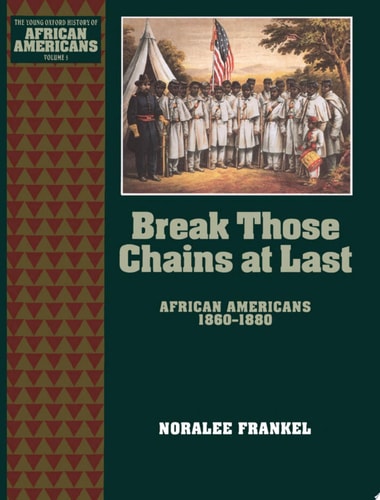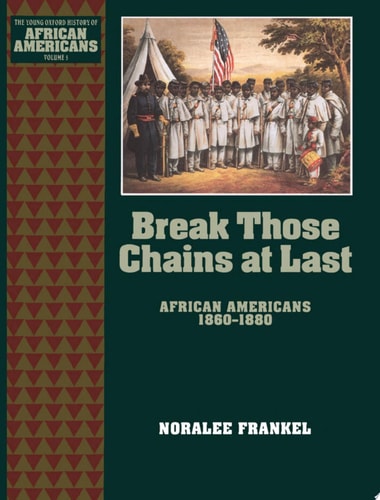
Break Those Chains at Last: African Americans 1860-1880
0
0
As an Amazon Associate and affiliate partner, Menrva Books earns from qualifying purchases. Learn more
Author Description
"We thought we'd break those chains at last," sang the slaves, hoping such spirituals would sustain them until the Confederacy surrendered and slavery was gone forever. During the Civil War, blacks served in the Union army and navy (although some fought for the South) and in Union-controlled camps, which harbored fleeing slaves. Not all slaves escaped, but even those who remained with their masters began to imagine a new life. After the war, amendments to the Constitution abolished slavery, granted citizenship to freed people, and gave African-American men the right to vote. Freedom, blacks hoped, would also mean political equality and economic well-being. Some moved from rural areas to cities in the South or North; others looked to the West, where many African-American men became farmers or found work as cattle-drive cooks and cowboys. But many whites viewed freedom for African Americans as a threat, and they responded by establishing white supremacy organizations such as the Ku Klux Klan. Organized violence against blacks, along with poor agricultural conditions, discrimination, and worsening economic times, guaranteed poverty for most Southern blacks. Although the tightly knit slave communities on the larger plantations began to disperse, a sense of having shared interests and goals actually widened freed people's vision of the meaning of community. Despite fierce white opposition, African Americans established their own churches, schools, and other associations and began to participate actively in government. Break Those Chains at Last tells the story of these turbulent and complicated years, as African Americans created the communities and organizations that survive to this day.
Menrva's Summary
THE THESIS
This book investigates the complex transition of African Americans from enslavement to freedom during the pivotal two decades between 1860 and 1880. Noralee Frankel, a historian specializing in gender and African American history, utilizes primary source accounts and historical records to examine how freed people navigated the collapse of the Confederacy, the promise of Constitutional amendments, and the rise of systemic white supremacist violence. The text argues that despite severe economic and political opposition, African Americans successfully forged new community structures, educational institutions, and political identities that laid the foundation for future generations.
THE SCOPE MAP
What You Will Find
- Analysis of the Civil War era, the abolition of slavery, and the Reconstruction period.
- Examination of migration patterns from rural plantations to urban centers and the American West.
- Documentation of the establishment of independent churches, schools, and civic associations.
- Overview of the rise of organized white supremacy groups like the Ku Klux Klan.
Scope Limits
- The text focuses primarily on the United States, with limited discussion of international perspectives on the abolitionist movement.
- The narrative is tailored for a younger audience, prioritizing accessibility over exhaustive academic historiography.
THE AUTHORITY PERSPECTIVE
Educators and historians frequently cite this volume as a reliable, accessible introduction to the Reconstruction era for students and general readers. The prose is noted for its clarity and ability to synthesize complex legislative and social shifts into a coherent historical narrative.
Page Count:
144
Publication Date:
1996-01-01
Publisher:
Oxford University Press
ISBN-10:
0190282290
ISBN-13:
9780190282295
History
United States
Social History
Civil War
African American
Reconstruction Era
Minority Studies