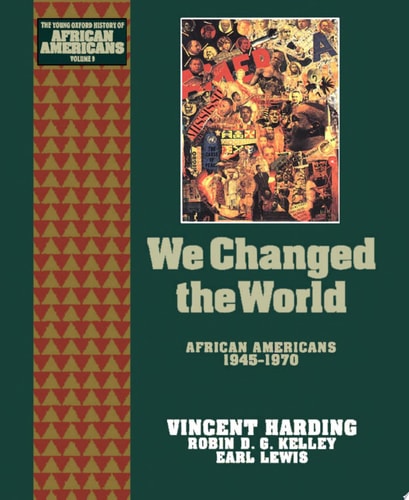
We Changed the World: African Americans 1945-1970
0
0
As an Amazon Associate and affiliate partner, Menrva Books earns from qualifying purchases. Learn more
Author Description
For all of the continuity of African-American history, including the long history of struggle, the years between 1945 and 1970 represented a new moment. It was a time of new possibilities and new vision, a time when black Americans were determined to be the architects of an inclusive America that championed human rights for all. In We Changed the World, Vincent Harding, himself a participant in the Southern freedom movement, documents what was perhaps the most critical chapter in African-American history, the fight for civil and human rights. In the streets and in the courts, a new generation of black activists--including Rosa Parks, Martin Luther King, Jr., Malcolm X, writers James Baldwin and Ralph Ellison, and baseball legend Jackie Robinson--forced the federal government to admit that segregation was wrong and must be remedied. Their efforts paid off. In the 1954 Brown v. Board of Education decision, the Supreme Court overturned Plessy v. Ferguson, the 1896 decision upholding legal segregation. Americans could no longer easily avoid the implications of Martin Luther King, Jr.'s central message: "If democracy is to live segregation must die." By 1964, African Americans had much to be optimistic about. Protests in Birmingham and Mississippi and the much publicized murders of civil rights activists forced Congress to pass the Civil Rights Act of 1964, which outlawed segregation in public accommodations of every kind throughout the country. The civil rights movement freed all African Americans to move beyond protest and to take charge themselves. The Black Power movement, the Voting Rights Act of 1965, the urban rebellions--all contributed to the transformation of American politics and the role of black Americans in the life of the nation. African Americans did indeed change the world, but only after a long struggle that began when the first Africans arrived in this country. It is a struggle that continues to this day.
Menrva's Summary
THE THESIS
This book investigates how the period between 1945 and 1970 served as a critical turning point in the African American struggle for civil and human rights. Vincent Harding, a historian and active participant in the Southern freedom movement, utilizes his unique perspective to analyze the transformation of American politics. He argues that this era of activism, led by figures such as Martin Luther King, Jr. and Rosa Parks, fundamentally reshaped the nation's legal and social landscape by forcing a confrontation with the realities of segregation.
THE SCOPE MAP
What You Will Find
- Analysis of the Civil Rights Movement from 1945 to 1970
- Examination of landmark legal cases including Brown v. Board of Education
- Documentation of the transition from protest to the Black Power movement
- Profiles of key activists and cultural figures of the era
Scope Limits
- Does not provide a comprehensive history of the entire African American experience
- Focuses primarily on the political and social developments within the United States during the specified twenty-five-year window
THE AUTHORITY PERSPECTIVE
Experts frequently cite this work as a valuable, accessible resource for understanding the complexities of the mid-twentieth-century civil rights era. Readers note that Harding's personal involvement in the movement adds a layer of authenticity to the historical narrative.
Page Count:
192
Publication Date:
1997-01-01
Publisher:
Oxford University Press
ISBN-10:
0190282282
ISBN-13:
9780190282288
History
Civil Rights
African American
United States
20th Century
Minority Studies
Community Tags
Other Editions(2)
Similar Books
Reader Comments
Share Your Thoughts
No comments yet. Be the first to share your thoughts!