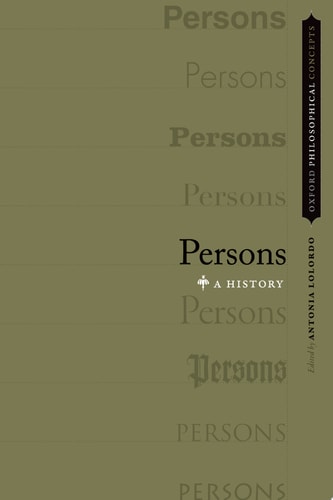
Persons: A History
0
0
As an Amazon Associate and affiliate partner, Menrva Books earns from qualifying purchases. Learn more
Author Description
What is a person? Why do we count certain beings as persons and others not? How is the concept of a person distinct from the concept of a human being, or from the concept of the self? When and why did the concept of a person come into existence? What is the relationship between moral personhood and metaphysical personhood? How has their relationship changed over the last two millennia?This volume presents a genealogy of the concept of a person. It demonstrates how personhood--like the other central concepts of philosophy, law, and everyday life--has gained its significance not through definition but through the accretion of layers of meaning over centuries. We can only fully understand the concept by knowing its history. Essays show further how the concept of a person has five main strands: persons are particulars, roles, entities with special moral significance, rational beings, and selves. Thus, to count someone or something as a person is simultaneously to describe it--as a particular, a role, a rational being, and a self--and to prescribe certain norms concerning how it may act and how others may act towards it. A group of distinguished thinkers and philosophers here untangle these and other insights about personhood, asking us to reconsider our most fundamental assumptions of the self.
Menrva's Summary
THE THESIS
This volume investigates the historical evolution and conceptual architecture of the term 'person' to determine how it functions as both a descriptive and prescriptive category. Antonia LoLordo, alongside a group of distinguished philosophers, examines how the concept of personhood has accumulated layers of meaning over two millennia. By tracing the development of this concept through law, philosophy, and social practice, the contributors argue that personhood cannot be understood through a static definition but rather through its historical accretion of five distinct strands: particulars, roles, moral entities, rational beings, and selves.
THE SCOPE MAP
What You Will Find
- A genealogical analysis of the concept of personhood spanning two millennia.
- A framework identifying five core strands of personhood: particulars, roles, moral entities, rational beings, and selves.
- Philosophical inquiries into the distinction between human beings, selves, and persons.
Scope Limits
- The text does not provide a singular, universal definition of personhood.
- The analysis focuses primarily on Western philosophical and legal traditions rather than cross-cultural or non-Western perspectives.
THE AUTHORITY PERSPECTIVE
Experts identify this volume as a significant contribution to the Oxford Philosophical Concepts series, noting its utility for scholars interested in the intersection of ethics and metaphysics. Readers frequently highlight the academic rigor of the essays, which provide a structured approach to understanding the complex, layered history of the self.
Page Count:
410
Publication Date:
2019-01-01
Publisher:
Oxford University Press
ISBN-10:
0190634413
ISBN-13:
9780190634414
Philosophy
Philosophy history
History & Surveys
Metaphysics
Persons
Philosophical anthropology
Intellectual History
Ethics
Community Tags
Similar Books