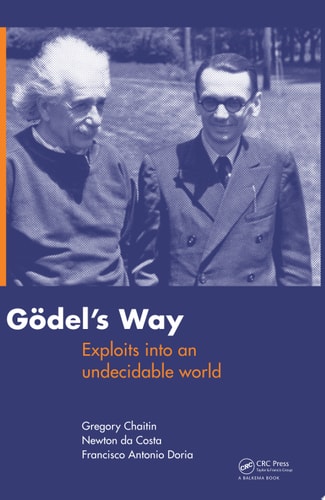
Goedel's Way: Exploits into an Undecidable World
0
0
As an Amazon Associate and affiliate partner, Menrva Books earns from qualifying purchases. Learn more
Author Description
Kurt Gödel (1906-1978) was an Austrian-American mathematician, who is best known for his incompleteness theorems. He was the greatest mathematical logician of the 20th century, with his contributions extending to Einstein's general relativity, as he proved that Einstein's theory admits time machines. The Gödel incompleteness phenomenon - one cannot prove nor disprove all true mathematical sentences in the usual formal mathematical sentences - is frequently presented in textbooks as something that happens in the rarefied realms of mathematical logic, and that has nothing to do with the real world. Practice shows the contrary though; one can demonstrate the validity of the phenomenon in various areas, ranging from chaos theory and physics to economics and even ecology. In this lively treatise, based on Chaitin's work and on the da Costa-Doria results in physics, ecology, economics and computer science, the authors show that the Gödel incompleteness phenomenon can directly bear on the practice of science and perhaps on our everyday life. This accessible book gives a new, detailed and elementary explanation of the Gödel incompleteness theorems and presents the Chaitin results and their relation to the da Costa-Doria results, which are given in full, but with no technicalities. Besides theory, the historical report and personal stories about the main character and on this book's writing process, make it appealing leisure reading for those interested in mathematics, logic, physics, philosophy and computer sciences.
Menrva's Summary
THE THESIS
This book investigates whether the mathematical incompleteness phenomenon, traditionally confined to abstract logic, exerts a tangible influence on empirical sciences and everyday reality. The authors, including noted mathematician Gregory Chaitin and researchers Newton C. A. da Costa and Francisco A. Doria, synthesize their specialized findings to argue that Gödel's theorems are not merely theoretical curiosities. By bridging the gap between formal logic and practical disciplines like chaos theory, economics, and ecology, the text provides a framework for understanding how undecidability permeates complex systems.
THE SCOPE MAP
What You Will Find
- An elementary explanation of Gödel's Incompleteness Theorems and their foundational implications.
- Analysis of Chaitin's algorithmic information theory and its relation to the Da Costa-Doria results.
- Applications of incompleteness across diverse fields including physics, ecology, and computer science.
- Historical context and personal anecdotes regarding the development of these mathematical concepts and the writing process of the volume.
THE AUTHORITY PERSPECTIVE
Experts and readers alike note that the authors successfully distill highly technical mathematical concepts into an accessible format for a general audience. The text is frequently cited as a valuable resource for those seeking to understand the broader philosophical and scientific implications of logic without becoming bogged down in dense, formal proofs.
Page Count:
160
Publication Date:
2011-01-01
Publisher:
Taylor & Francis Group
ISBN-10:
0415690854
ISBN-13:
9780203169575
Biography
Philosophy
Physics
Computer Science
Mathematics
Logic
Community Tags
Similar Books