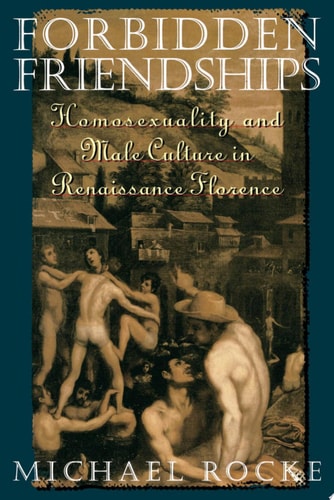
Forbidden Friendships: Homosexuality and Male Culture in Renaissance Florence
0
0
As an Amazon Associate and affiliate partner, Menrva Books earns from qualifying purchases. Learn more
Author Description
The men of Renaissance Florence were so renowned for sodomy that "Florenzer" in German meant "sodomite." Indeed, in the late fifteenth century, as many as one in two Florentine men had come to the attention of the authorities for sodomy by the time they were thirty. In the seventy years from 1432 to 1502, some 17,000 men--in a city of only 40,000--were investigated for sodomy; 3,000 were convicted and thousands more confessed to gain amnesty. Michael Rocke vividly depicts this vibrant sexual culture in a world where these same-sex acts were not the deviant transgressions of a small minority, but an integral part of a normal masculine identity. In 1432 The Office of the Night was created specifically to police sodomy in Florence. Seventy years of denunciations, interrogations, and sentencings left an extraordinarily detailed record, which Rocke uses to its fullest in this richly documented portrait. He describes a wide range of sexual experiences between males, ranging from boys such as fourteen-year-old Morello di Taddeo, who prostituted himself to fifty-seven men, to the notorious Jacopo di Andrea, a young bachelor implicated with forty adolescents over a seventeen-year period and convicted thirteen times; same-sex "marriages" like that of Michele di Bruno and Carlo di Berardo, who were involved for several years and swore a binding oath to each other over an altar; and Bernardo Lorini, a former Night Officer himself with a wife and seven children, accused of sodomy at the age of sixty-five. (Mortified, he sent his son Taddeo to confess for him and plead for a discreet resolution of his case.) Indeed, nearly all Florentine males probably had some kind of same-sex experience as a part of their "normal" sexual life. Rocke uncovers a culture in which sexual roles were strictly defined by age, with boys under eighteen the "passive" participants in sodomy, youths in their twenties and older men the "active" participants, and most men at the age of thirty marrying women,
Menrva's Summary
THE THESIS
This work investigates how same-sex behavior functioned as a normalized component of masculine identity and social structure in Renaissance Florence. Michael Rocke, a historian specializing in Italian social history, utilizes extensive archival records from the Office of the Night to reconstruct the sexual landscape of the city. He argues that sodomy was not viewed as a marginal or deviant act by a minority, but rather as an pervasive practice integrated into the lives of a significant portion of the male population.
THE SCOPE MAP
What You Will Find
- Analysis of 17,000 judicial records from the Office of the Night between 1432 and 1502.
- Examination of age-based sexual roles and social hierarchies among Florentine males.
- Case studies of individuals ranging from adolescents to established heads of households.
- Documentation of same-sex unions and the social rituals surrounding them.
Scope Limits
- The study focuses primarily on the male experience and does not provide an equivalent analysis of female same-sex relations.
- The research is geographically confined to the city of Florence and its immediate administrative jurisdiction.
THE AUTHORITY PERSPECTIVE
Historians and scholars of the Renaissance frequently cite this work as a foundational text for understanding the intersection of sexuality and social order in early modern Europe. Readers often note the academic density of the prose, which relies heavily on primary source documentation to support its sociological conclusions.
Page Count:
377
Publication Date:
1998-01-01
Publisher:
Oxford University Press
ISBN-10:
0190284129
ISBN-13:
9780190284121
History
Homophobia
Sodomy
Gay Men
Gender Studies
European History
Social History
Cultural History
Gay Studies
LGBTQ history
Florence Italy
Community Tags
Other Editions(3)

Similar Books








Reader Comments
Share Your Thoughts
No comments yet. Be the first to share your thoughts!