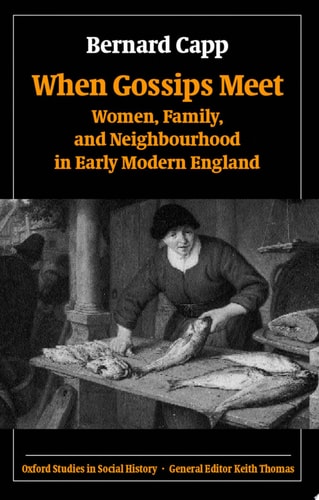
When Gossips Meet: Women, Family, and Neighbourhood in Early Modern England
0
0
As an Amazon Associate and affiliate partner, Menrva Books earns from qualifying purchases. Learn more
Author Description
This book explores how women of the poorer and middling sorts in early modern England negotiated a patriarchal culture in which they were generally excluded, marginalized, or subordinated. It focuses on the networks of close friends ('gossips') which gave them a social identity beyond the narrowly domestic, providing both companionship and practical support in disputes with husbands and with neighbours of either sex. The book also examines the micropolitics of the household, with its internal alliances and feuds, and women's agency in neighbourhood politics, exercised by shaping local public opinion, exerting pressure on parish officials, and through the role of informal female juries. If women did not openly challenge male supremacy, they could often play a significant role in shaping their own lives and the life of the local community.
Menrva's Summary
THE THESIS
This work investigates how women of the lower and middling classes in early modern England navigated a patriarchal society to establish social agency and community influence. Bernard Capp, a historian specializing in early modern social history, utilizes court records, diaries, and local administrative documents to reconstruct the lives of women outside the elite sphere. The central argument posits that female networks, or 'gossips,' functioned as vital support systems that allowed women to exert power within the household and the broader neighborhood despite their formal exclusion from political and legal authority.
THE SCOPE MAP
What You Will Find
- Analysis of female social networks and the role of 'gossips' in providing companionship and conflict resolution.
- Examination of household micropolitics, including internal alliances and domestic disputes.
- Investigation into women's participation in local governance, such as influencing parish officials and serving on informal female juries.
Scope Limits
- The study focuses primarily on the poorer and middling sorts, excluding the experiences of the aristocracy and elite classes.
- The research is geographically confined to early modern England and does not extend to continental European social structures.
THE AUTHORITY PERSPECTIVE
Historians and scholars of early modern social structures frequently cite this text as a foundational resource for understanding the informal power dynamics of the period. Readers often note the academic density of the prose, which is balanced by the author's extensive use of primary source evidence to support his claims regarding female agency.
Page Count:
408
Publication Date:
2003-01-01
Publisher:
Oxford University Press
ISBN-10:
0191555088
ISBN-13:
9780191555084
History
Sociology
Early Modern
Gender Studies
Great Britain
European History
Women Studies
Social History
Women
Community Tags
Similar Books