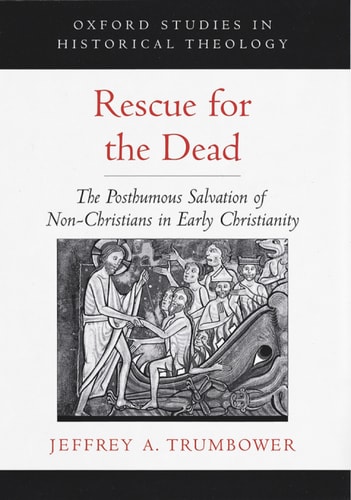
Rescue for the Dead: The Posthumous Salvation of Non-Christians in Early Christianity
0
0
As an Amazon Associate and affiliate partner, Menrva Books earns from qualifying purchases. Learn more
Author Description
Christianity is a religion of salvation in which believers have always anticipated post-mortem bliss for the faithful and non-salvation for others. Here, Trumbower examines how and why death came to be perceived as such a firm boundary of salvation. Analyzing exceptions to this principle from ancient Christianity, he finds that the principle itself was slow to develop and not universally accepted in the Christian movement's first four hundred years. In fact, only in the West was this principle definitively articulated, due in large part to the work and influence of Augustine.
Menrva's Summary
THE THESIS
This book investigates the historical development of the Christian doctrine of post-mortem salvation and the specific conditions under which the boundary between the saved and the damned became solidified. Jeffrey A. Trumbower, a scholar of early Christian history, utilizes a wide array of primary sources from the first four centuries of the movement to challenge the assumption that the exclusion of non-Christians from salvation was an immediate or universal tenet. He argues that this rigid boundary was a gradual construction, heavily influenced by Western theological shifts, particularly the contributions of Augustine of Hippo.
THE SCOPE MAP
What You Will Find
- Analysis of early Christian texts regarding the afterlife and salvation.
- Examination of diverse views on post-mortem hope for non-believers.
- Historical context of the transition from pluralistic views to dogmatic exclusion.
- Focus on the divergence between Eastern and Western theological developments.
Scope Limits
- The study is primarily confined to the first four hundred years of the Christian movement.
- It does not provide an exhaustive survey of medieval or modern theological developments regarding the afterlife.
THE AUTHORITY PERSPECTIVE
Scholars and historians of religion frequently cite this work as a rigorous examination of the fluidity of early Christian doctrine. Experts highlight the text for its meticulous use of primary sources to demonstrate how theological consensus was shaped by specific historical and regional influences.
Page Count:
222
Publication Date:
2001-01-01
Publisher:
Oxford University Press
ISBN-10:
0190286385
ISBN-13:
9780190286385
History
Religion
Christianity
Church History
Theology
Salvation Outside The Church
Community Tags
Similar Books