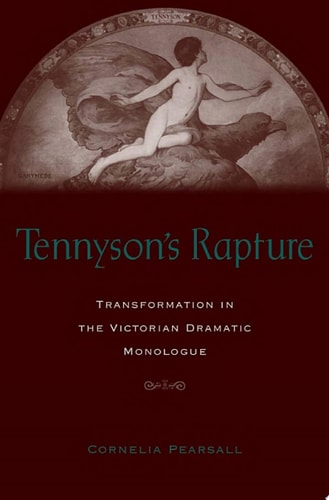
Tennyson's Rapture: Transformation in the Victorian Dramatic Monologue
0
0
As an Amazon Associate and affiliate partner, Menrva Books earns from qualifying purchases. Learn more
Author Description
In the wake of the death of his friend Arthur Henry Hallam, the subject of In Memoriam, Alfred Tennyson wrote a range of intricately connected poems, many of which feature pivotal scenes of rapture, or being carried away. This book explores Tennyson's representation of rapture as a radical mechanism of transformation-theological, social, political, or personal-and as a figure for critical processes in his own poetics. The poet's fascination with transformation is figured formally in the genre he is credited with inventing, the dramatic monologue. Tennyson's Rapture investigates the poet's previously unrecognized intimacy with the theological movements in early Victorian Britain that are the acknowledged roots of contemporary Pentacostalism, with its belief in the oncoming Rapture, and its formative relation to his poetic innovation. Tennyson's work recurs persistently as well to classical instances of rapture, of mortals being borne away by immortals. Pearsall develops original readings of Tennyson's major classical poems through concentrated attention to his profound intellectual investments in advances in philological scholarship and archeological exploration, including pressing Victorian debates over whether Homer's raptured Troy was a verifiable site, or the province of the poet's imagination. Tennyson's attraction to processes of personal and social change is bound to his significant but generally overlooked Whig ideological commitments, which are illuminated by Hallam's political and philosophical writings, and a half-century of interaction with William Gladstone. Pearsall shows the comprehensive engagement of seemingly apolitical monologues with the rise of democracy over the course of Tennyson's long career. Offering a new approach to reading all Victorian dramatic monologues, this book argues against a critical tradition that sees speakers as unintentionally self-revealing and ignorant of the implications of their speech. Tennyson's Rapture probes the complexities of the poet's work.
Menrva's Summary
THE THESIS
This book investigates how Alfred Tennyson utilized the concept of 'rapture' as both a theological mechanism and a formal poetic device to navigate the personal, political, and social transformations of the Victorian era. Cornelia D. J. Pearsall, an expert in Victorian literature, synthesizes archival research, philological scholarship, and political history to argue that Tennyson’s dramatic monologues are not merely self-revealing exercises, but intentional, sophisticated engagements with the ideological shifts of his time. By connecting Tennyson’s work to early Pentecostal roots and Whig political thought, Pearsall provides a framework for understanding the poet's innovation within the context of nineteenth-century intellectual life.
THE SCOPE MAP
What You Will Find
- Analysis of Tennyson's dramatic monologues as formal vehicles for transformation.
- Examination of the intersection between Victorian theology and the origins of modern Pentecostalism.
- Integration of classical scholarship, archeological debates regarding Troy, and philological advancements.
- Exploration of the influence of Arthur Henry Hallam and William Gladstone on Tennyson's political ideology.
Scope Limits
- The analysis focuses primarily on Tennyson's specific interpretation of rapture rather than a comprehensive survey of all Victorian poetry.
- The text assumes a high level of familiarity with Victorian political history and classical literature.
THE AUTHORITY PERSPECTIVE
Scholars recognize this work as a significant contribution to the study of Tennyson’s formal innovations and his ideological positioning within the Victorian landscape. Readers frequently note the academic density of the prose, which is tailored for specialists in nineteenth-century studies and literary theory.
Page Count:
408
Publication Date:
2008-01-01
Publisher:
Oxford University Press
ISBN-10:
0190287810
ISBN-13:
9780190287818
English & College Success
Monologue
History of religion
Academic
Victorian
English
Literary Criticism
Political Theory
Community Tags
Similar Books