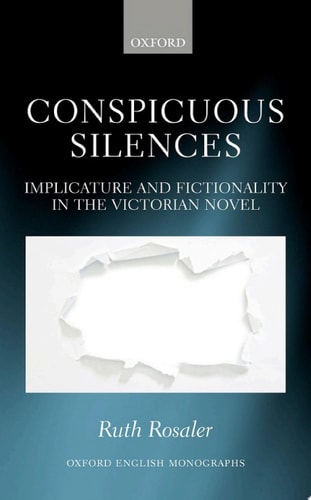
Conspicuous Silences: Implicature and Fictionality in the Victorian Novel
0
0
As an Amazon Associate and affiliate partner, Menrva Books earns from qualifying purchases. Learn more
Author Description
How are a reader's perceptions of a plot impacted by its presentation through textual clues rather than explicit narration, and why would an author choose this comparatively indirect mode of narration? Conspicuous Silences answers these questions by examining Victorian novels in which pivotal events are left inexplicit for hundreds of pages at a time, but are nonetheless evident to the reader. The clarity with which readers understand these inexplicit plot lines is evidenced by their ability to follow the progression of narratives that rely heavily on the inexplicit content being detected; without this reader comprehension, these narratives would be deemed incoherent. In linguistics, communications that depend on a hearer's or reader's inference, rather on their 'decoding' the explicit content of an utterance, are termed 'implicatures'. Conspicuous Silences explores the impact that central, sustained implicatures have on a reader's experience of a novel. It also discusses how authors may generate those implicatures by exploiting the reader's assumption of narratorial omniscience, and the correlated reader assumption of a narrative's fictionality. Reliance on such sustained, fictionality-related implicatures is fairly ubiquitous: Conspicuous Silences concentrates on texts by Elizabeth Gaskell, George Eliot, Charles Dickens, Frances Trollope, Anthony Trollope, Wilkie Collins, and M. E. Braddon. It examines the use of implicature in communicating impolite topics, communicating character psychology, and in fashioning a playful narrative tone. This work contributes to Victorian literary scholarship, narratological discussions about narratorial omniscience and fictionality, and pragmatic stylistic debates about fictionality and the use of implicature.
Menrva's Summary
THE THESIS
How do Victorian novelists utilize linguistic implicature to convey pivotal plot points and character psychology without explicit narration? Ruth Rosaler, a scholar of Victorian literature and linguistics, investigates the mechanics of indirect communication within the 19th-century novel. By applying pragmatic linguistic theory to canonical texts, she argues that authors intentionally exploit reader assumptions regarding narratorial omniscience and the nature of fictionality to sustain complex, inexplicit narrative threads.
THE SCOPE MAP
What You Will Find
- Analysis of sustained implicatures in Victorian prose.
- Application of Gricean pragmatic theory to literary narrative structures.
- Examination of how authors communicate sensitive topics and internal psychology through omission.
- Comparative study of works by Gaskell, Eliot, Dickens, the Trollopes, Collins, and Braddon.
Scope Limits
- The study focuses primarily on the Victorian period and does not extend to modern or postmodern narrative techniques.
- It does not provide a comprehensive history of the Victorian novel, but rather a specific stylistic analysis of indirect narration.
THE AUTHORITY PERSPECTIVE
Scholars in the field of Victorian studies and narratology recognize this work as a rigorous bridge between linguistic pragmatics and literary analysis. Readers frequently note the academic density of the prose, which is intended for an audience familiar with both 19th-century literature and formal linguistic theory.
Page Count:
194
Publication Date:
2016-01-01
Publisher:
OUP Oxford
ISBN-10:
0191082376
ISBN-13:
9780191082375
Academic
Literary theory
English
Narratology
Linguistics
English & College Success
Literary Criticism
Victorian
English fiction