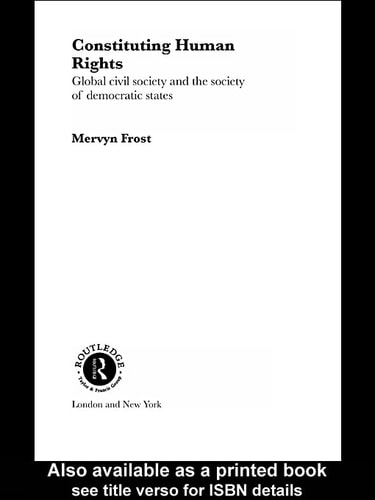
Constituting Human Rights
0
0
As an Amazon Associate and affiliate partner, Menrva Books earns from qualifying purchases. Learn more
Author Description
Global civil society and the society of democratic states are the two most inclusive and powerful global practices of our time. In this book Frost claims that, without an understanding of the role that individual human rights play in these practices, no adequate understanding of any major feature of contemporary world politics from 'globalization' to 'new wars' is possible. Therefore, Constituting Human Rights argues that a concern with human rights is essential to the study of international relations.Global civil society comprises those millions of people worldwide who claim first generation rights for themselves. By doing so they constitute one another as civilians. The language of rights used in this practice indicates that it is a practice that is open to all and without borders. Strikingly, the validity of claims made in it are not conceptually linked to any specific legal system or sovereign state. Within democratic states, however, the participants constitute one another as holders of citizenship rights, as people with a right to participate in self-government. Frost holds that the rights claims made in this practice are only real insofar as they build on the civilian rights of the earlier practice.An understanding of the centrality of rights claims and the practices in which they are located provides a much needed guide to all of us concerned to understand contemporary international relations and concerned about ethical conduct in world affairs. This exercise in constitutive theory puts forward a powerful tool with which to tackle some of the pressing ethical issues of our time such as those to do with refugees, asylum seekers, new wars, secessionist movements, international labour practices and many more.
Menrva's Summary
THE THESIS
This book investigates the fundamental role that individual human rights play in constituting the two most significant global practices of our time: global civil society and the society of democratic states. Mervyn Frost, a scholar of international relations, argues that a comprehensive understanding of contemporary world politics—including globalization and modern conflict—is impossible without first grasping how rights claims define these global structures. He presents a constitutive theory that links the civilian rights claimed within global civil society to the citizenship rights exercised within democratic states, asserting that the latter rely upon the former for their legitimacy.
THE SCOPE MAP
What You Will Find
- A theoretical framework for understanding global civil society versus the society of democratic states.
- An analysis of how rights claims function as constitutive elements of political identity.
- Application of constitutive theory to modern ethical dilemmas such as refugee status, asylum, and secessionist movements.
- A critical examination of the relationship between international labor practices and sovereign state obligations.
THE AUTHORITY PERSPECTIVE
Experts in international relations theory recognize this work as a significant contribution to the study of constitutive theory and global ethics. Readers frequently note the academic density of the prose, which serves as a rigorous guide for those seeking to understand the intersection of human rights and international political structures.
Page Count:
0
Publication Date:
2004-01-01
Publisher:
Taylor & Francis Inc
ISBN-10:
0203258282
ISBN-13:
9780203258286
Philosophy
Nonfiction
Political Freedom
International relations
Relations Internationales
Human rights
Politics
Civil society
Société civile
Ethics