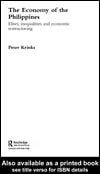
The Economy of the Philippines
0
0
As an Amazon Associate and affiliate partner, Menrva Books earns from qualifying purchases. Learn more
Author Description
In the late 1950s, the Filipino economy could reasonably have been described as more advanced than those of its South Asian neighbours. Ever since then, however, it has consistently lagged behind and only really started to grow strongly in the mid-1990s and even then it failed to achieve the growth rates of the rest of Southeast Asia ten years earlier.This book critically analyses the Filipino economy and attempts to explain the problems that it has faced, as well as the solutions that need to be put into practice.This accessible and comprehensive book will be of great use to students, academics and business professionals with an interest in the economies of Asia.
Menrva's Summary
THE THESIS
This book investigates the historical stagnation of the Philippine economy relative to its Southeast Asian neighbors and identifies the structural impediments to sustained growth. Peter A. Krinks, an established scholar in regional economic studies, utilizes historical data and comparative analysis to evaluate the country's economic trajectory from the late 1950s through the late 1990s. The text argues that specific policy failures and institutional constraints prevented the nation from achieving the rapid development seen elsewhere in the region, while proposing necessary reforms to foster future stability.
THE SCOPE MAP
What You Will Find
- Comparative economic analysis between the Philippines and other Southeast Asian nations.
- Historical review of economic performance from the 1950s to the 1990s.
- Identification of structural barriers to industrial and agricultural growth.
- Policy recommendations for improving national economic output and stability.
THE AUTHORITY PERSPECTIVE
Experts recognize this work as a foundational text for understanding the specific developmental challenges faced by the Philippines during the late 20th century. Readers frequently note the clarity of the prose, which makes complex economic history accessible to both students and business professionals.
Page Count:
0
Publication Date:
2003-01-01
Publisher:
Taylor & Francis Group Plc
ISBN-10:
0203264711
ISBN-13:
9780203264713
Economics
History
Economic History
Industrie
Asia
Nonfiction
Philippines
Community Tags
Similar Books