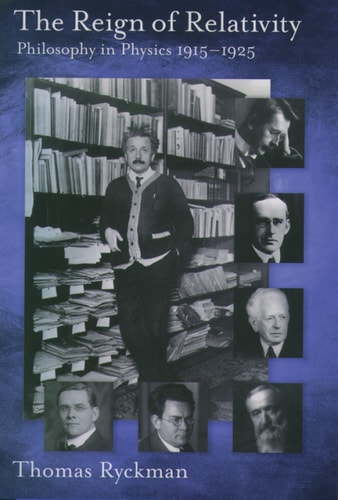
The Reign of Relativity: Philosophy in Physics 1915-1925
0
0
As an Amazon Associate and affiliate partner, Menrva Books earns from qualifying purchases. Learn more
Author Description
Universally recognized as bringing about a revolutionary transformation of the notions of space, time, and motion in physics, Einstein's theory of gravitation, known as "general relativity," was also a defining event for 20th century philosophy of science. During the decisive first ten years of the theory's existence, two main tendencies dominated its philosophical reception. This book is an extended argument that the path actually taken, which became logical empiricist philosophy of science, greatly contributed to the current impasse over realism, whereas new possibilities are opened in revisiting and reviving the spirit of the more sophisticated tendency, a cluster of viewpoints broadly termed transcendental idealism, and furthering its articulation. It also emerges that Einstein, while paying lip service to the emerging philosophy of logical empiricism, ended up siding de facto with the latter tendency. Ryckman's work speaks to several groups, among them philosophers of science and historians of relativity. Equations are displayed as necessary, but Ryckman gives the non-mathematical reader enough background to understand their occurrence in the context of his wider philosophical project.
Menrva's Summary
THE THESIS
This work investigates how the philosophical reception of Einstein's general relativity between 1915 and 1925 shaped the trajectory of 20th-century philosophy of science. Thomas Ryckman, a scholar specializing in the history and philosophy of physics, utilizes historical records and primary philosophical texts to argue that the dominance of logical empiricism created an impasse regarding scientific realism. He proposes that revisiting the alternative tradition of transcendental idealism offers a more robust framework for understanding the physical and conceptual implications of Einstein's theory.
THE SCOPE MAP
What You Will Find
- A detailed analysis of the philosophical climate surrounding the emergence of general relativity.
- A comparative study between logical empiricism and transcendental idealism.
- Contextualized explanations of the mathematical foundations of Einstein's gravitation theory.
Scope Limits
- The text does not provide a comprehensive technical manual for general relativity calculations.
- The analysis is strictly confined to the decade between 1915 and 1925.
THE AUTHORITY PERSPECTIVE
Experts in the history of science recognize this text as a rigorous examination of the intersection between early 20th-century physics and epistemology. Readers frequently note the academic density of the prose, which requires a foundational understanding of both philosophical terminology and the history of modern physics.
Page Count:
329
Publication Date:
2005-01-01
Publisher:
Oxford University Press
ISBN-10:
0190292156
ISBN-13:
9780190292157
Philosophy
Relativity
General Relativity
History & Surveys
Philosophy of
Science History
Physics
Community Tags
Similar Books