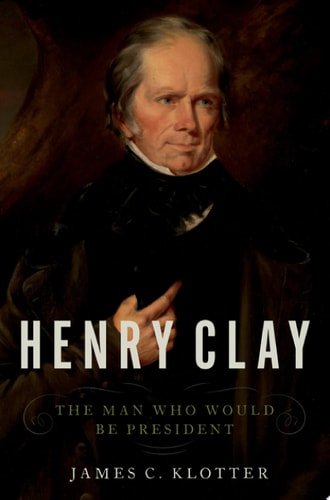
Henry Clay: The Man Who Would Be President
0
0
As an Amazon Associate and affiliate partner, Menrva Books earns from qualifying purchases. Learn more
Author Description
Charismatic, charming, and one of the best orators of his era, Henry Clay seemed to have it all. He offered a comprehensive plan of change for America, and he directed national affairs as Speaker of the House, as Secretary of State to John Quincy Adams--the man he put in office--and as acknowledged leader of the Whig party. As the broker of the Missouri Compromise and the Compromise of 1850, Henry Clay fought to keep a young nation united when westward expansion and slavery threatened to tear it apart. Yet, despite his talent and achievements, Henry Clay never became president. Three times he received Electoral College votes, twice more he sought his party's nomination, yet each time he was defeated. Alongside fellow senatorial greats Daniel Webster and John C. Calhoun, Clay was in the mix almost every moment from 1824 to 1848. Given his prominence, perhaps the years should be termed not the Jacksonian Era but rather the Age of Clay. James C. Klotter uses new research and offers a more focused, nuanced explanation of Clay's programs and politics in order to answer to the question of why the man they called "The Great Rejected" never won the presidency but did win the accolades of history. Klotter's fresh outlook reveals that the best monument to Henry Clay is the fact that the United States remains one country, one nation, one example of a successful democracy, still working, still changing, still reflecting his spirit. The appeal of Henry Clay and his emphasis on compromise still resonate in a society seeking less partisanship and more efforts at conciliation.
Menrva's Summary
THE THESIS
This work investigates why Henry Clay, a central figure in 19th-century American politics, consistently failed to secure the presidency despite his immense influence and legislative success. James C. Klotter, a noted historian, utilizes archival research to examine Clay's political programs and the structural challenges of his era. The book argues that Clay's legacy is defined not by his electoral losses, but by his role in maintaining national unity through compromise during a period of intense sectional conflict.
THE SCOPE MAP
What You Will Find
- A detailed analysis of the Missouri Compromise and the Compromise of 1850.
- An examination of Clay's leadership within the Whig party and his tenure as Speaker of the House.
- A comparative study of Clay, Daniel Webster, and John C. Calhoun.
Scope Limits
- The text does not provide a comprehensive biography of Clay's early childhood or private life outside of his political career.
- It focuses primarily on the period between 1824 and 1848 rather than the entirety of the 19th century.
THE AUTHORITY PERSPECTIVE
Historians and political scholars recognize this text as a nuanced re-evaluation of the Jacksonian Era, often praising its focus on legislative mechanics. Readers frequently note the academic density of the prose, which provides a thorough look at the complexities of early American political systems.
Page Count:
536
Publication Date:
2018-01-01
Publisher:
Oxford University Press
ISBN-10:
0190498064
ISBN-13:
9780190498061
History
Biography
19th Century
American History
Political History
United States
Community Tags
Similar Books