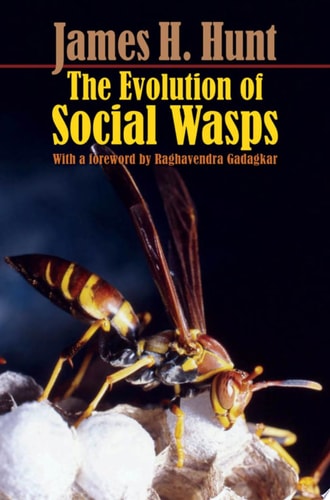
The Evolution of Social Wasps
0
0
As an Amazon Associate and affiliate partner, Menrva Books earns from qualifying purchases. Learn more
Author Description
Social behavior occurs in some of the smallest animals as well as some the largest, and the transition from solitary life to sociality is an unsolved evolutionary mystery. In The Evolution of Social Wasps, James H. Hunt examines social behavior in a single lineage of insects, wasps of the family Vespidae. He presents empirical knowledge of social wasps from two approaches, one that focuses on phylogeny and life history and one that focuses on individual ontogeny, colony development, and population dynamics. He also provides an extensive summary of the existing literature while demonstrating how it can be clouded by theory. Hunt's fresh approach to the conflicting literature on sociality highlights how oft repeated models can become fixed in the thinking of the scientific community. Instead, Hunt presents a mechanistic scenario for the evolution of sociality in wasps that changes our perspective on kin selection, the paradigm that has dominated thinking about social evolution since the 1970s. This innovative new model integrates life history, nutrition, fitness and ecology in which social insect biologists will find a rich storehouse of ideas and information, and behavioral ecologists will find a bracing challenge to long accepted models. Engagingly written, bold, and provocative, The Evolution of Social Wasps marks a milestone in our understanding of one of lifes major evolutionary transitions - the origin of social behavior.
Menrva's Summary
THE THESIS
This book investigates the evolutionary transition from solitary to social behavior by examining the specific lineage of Vespidae wasps. James H. Hunt, an expert in social insect biology, synthesizes empirical data regarding phylogeny, life history, and individual ontogeny. He challenges the long-standing dominance of kin selection theory by proposing a new mechanistic model that integrates nutrition, fitness, and ecology to explain the origins of sociality.
THE SCOPE MAP
What You Will Find
- Phylogenetic analysis of the Vespidae family
- Comparative study of individual ontogeny and colony development
- Integration of nutritional ecology and fitness models
- Critical review of existing social evolution literature
Scope Limits
- Does not provide a comprehensive survey of all social insects outside the Vespidae family
- Does not focus on non-biological or sociological applications of social behavior
THE AUTHORITY PERSPECTIVE
Experts in behavioral ecology recognize this text as a significant challenge to established paradigms regarding social evolution. Readers frequently note that the prose is both accessible and intellectually rigorous, making it a valuable resource for specialists and students alike.
Page Count:
259
Publication Date:
2007-01-01
Publisher:
Oxford University Press
ISBN-10:
0190294647
ISBN-13:
9780190294649
Nature
Science
Biology
Evolution
Zoology
Evolutionary Biology
Social Behavior
Entomology
Community Tags
Other Editions(3)

Similar Books