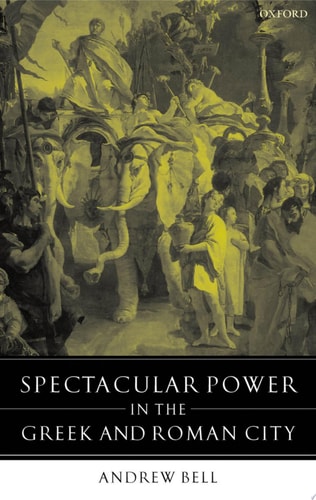
Spectacular Power in the Greek and Roman City
0
0
As an Amazon Associate and affiliate partner, Menrva Books earns from qualifying purchases. Learn more
Author Description
Andrew Bell's analysis of the power of prestige in civic communities of the ancient world demonstrates the importance of crowds' aesthetic and emotional judgement upon leaders and their ambitious claims for immediate and lasting significance; and also finds consideration of this dynamic still to be valuable for modern citizens. An initial discussion of the fall of Ceausescu in 1989 prompts theoretical considerations about the inseparability of authority and its manifestation; and scrutiny of Julius Caesar's gestures towards self-definition introduces the complexity of ancient political relations. The simultaneous presence of both popular affection for wondrous and kingly individuals, and also egalitarian suspicion of it, is detected in classical Athens, where an Alcibiades needed to manoeuvre craftily to achieve obvious and ritual pre-eminence in associating himself with age-old and Homeric models of distinction. Accordingly, the arrival of Hellenistic kingliness, such as that of Demetrios Poliorcetes, upon the political stage was neither wholly innovative nor unattractive. Yet such kings quite clearly articulated a new and grandiose majesty, as can be seen in parades in Egypt and Syria. With the growth of Roman imperialism, these stylings of personal power needed to be adapted to new realities and models, just as Romans of the later Republic increasingly found much to admire and emulate in others' spectacles. Thus the book comes back to the end of the Republic and to Cicero's struggles to maintain traditional, republican dignities in civic ceremony while a new Roman kingliness, thoroughly attentive to spectacular politics, was dawning.
Menrva's Summary
THE THESIS
This work investigates how the aesthetic and emotional judgment of the public functions as a critical component of political authority and prestige in ancient civic communities. Andrew Bell, a scholar of classical history, utilizes a comparative framework that bridges the gap between modern political events and the nuanced power dynamics of the ancient Mediterranean. By examining the tension between popular adulation and egalitarian suspicion, the author argues that the manifestation of power is inseparable from the spectacle created by those who wield it.
THE SCOPE MAP
What You Will Find
- Analysis of political self-definition in Classical Athens and the Roman Republic
- Examination of Hellenistic kingliness and its influence on Roman imperial imagery
- Comparative study of modern political collapses and ancient power structures
- Evaluation of Cicero's efforts to preserve republican dignity against emerging monarchical spectacle
Scope Limits
- The text does not provide a comprehensive history of all ancient political institutions
- It does not offer a prescriptive manual for modern political campaigning
THE AUTHORITY PERSPECTIVE
Scholars and students of classical history frequently note the book's ability to synthesize complex political theory with historical narrative. Experts highlight this as a valuable contribution to understanding the intersection of performance, public perception, and political legitimacy in the ancient world.
Page Count:
304
Publication Date:
2006-01-01
Publisher:
Oxford University Press
ISBN-10:
0191529303
ISBN-13:
9780191529306
History
Ancient - Rome
Power Social sciences
Prestige
Ancient Greece
Ancient History
Community Tags
Similar Books