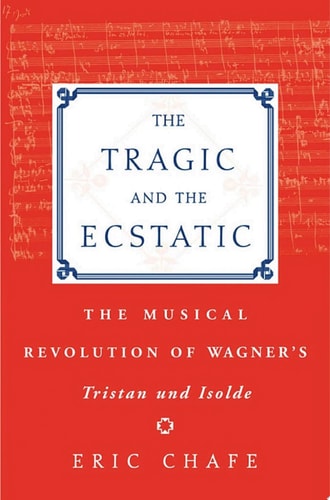
The Tragic and the Ecstatic: The Musical Revolution of Wagner's Tristan and Isolde
0
0
As an Amazon Associate and affiliate partner, Menrva Books earns from qualifying purchases. Learn more
Author Description
During the years preceding the composition of Tristan and Isolde, Wagner's aesthetics underwent a momentous turnaround, principally as a result of his discovery of Schopenhauer. Many of Schopenhauer's ideas, especially those regarding music's metaphysical significance, resonated with patterns of thought that had long been central to Wagner's aesthetics, and Wagner described the entry of Schopenhauer into his life as "a gift from heaven." Chafe argues that Wagner's Tristan and Isolde is a musical and dramatic exposition of metaphysical ideas inspired by Schopenhauer. The first part of the book covers the philosophical and literary underpinnings of the story, exploring Schopenhauer's metaphysics and Gottfried van Strassburg's Tristan poem. Chafe then turns to the events in the opera, providing tonal and harmonic analyses that reinforce his interpretation of the drama. Chafe acts as an expert guide, interpreting and illustrating most important moments for his reader. Ultimately, Chafe creates a critical account of Tristan, in which the drama is shown to develop through the music.
Menrva's Summary
THE THESIS
*This work investigates how Richard Wagner’s opera Tristan and Isolde serves as a musical and dramatic manifestation of Arthur Schopenhauer’s metaphysical philosophy.* Eric Chafe, a scholar of music theory, utilizes his expertise to bridge the gap between Wagner’s aesthetic evolution and the philosophical underpinnings of his most significant works. By synthesizing Schopenhauer’s theories on the nature of music with Gottfried von Strassburg’s literary source material, Chafe constructs a framework that demonstrates how Wagner’s harmonic innovations were intentionally designed to articulate complex metaphysical concepts.
THE SCOPE MAP
What You Will Find
- Philosophical analysis of Schopenhauer’s influence on 19th-century aesthetics
- Detailed tonal and harmonic analysis of the score of Tristan and Isolde
- Examination of the literary relationship between the opera and Gottfried von Strassburg’s poem
- Interpretive mapping of musical motifs to dramatic developments
Scope Limits
- The text does not provide a comprehensive biography of Wagner’s entire life
- It does not cover the performance history or staging evolution of the opera
THE AUTHORITY PERSPECTIVE
Musicologists and scholars frequently cite this text as a rigorous examination of the intersection between Wagnerian music theory and German philosophy. Readers often note the academic density of the prose, which requires a foundational understanding of both music theory and Schopenhauerian thought to fully appreciate the author's arguments.
Page Count:
344
Publication Date:
2005-01-01
Publisher:
Oxford University Press
ISBN-10:
0190292008
ISBN-13:
9780190292003
Philosophy
Musicology
Opera
Music theory
Richard Wagner
Music History
Humanities
Community Tags
Similar Books