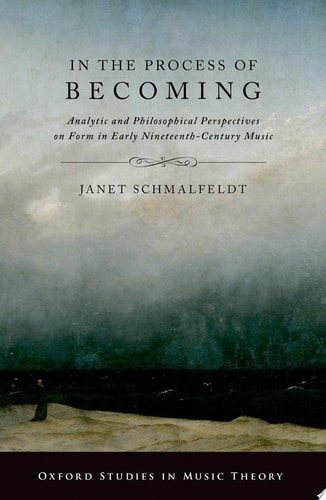
In the Process of Becoming: Analytic and Philosophical Perspectives on Form in Early Nineteenth-Century Music
0
0
As an Amazon Associate and affiliate partner, Menrva Books earns from qualifying purchases. Learn more
Author Description
With their insistence that form is a dialectical process in the music of Beethoven, Theodor Adorno and Carl Dahlhaus emerge as the guardians of a long-standing critical tradition in which Hegelian concepts have been brought to bear on the question of musical form. Janet Schmalfeldt's ground-breaking account of the development of this Beethoven-Hegelian tradition restores to the term "form" some of its philosophical associations in the early nineteenth century, when profound cultural changes were yielding new relationships between composers and their listeners, and when music itself-in particular, instrumental music-became a topic for renewed philosophical investigation. Precedents for Adorno's and Dahlhaus's concept of form as process arise in the Athenäum Fragments of Friedrich Schlegel and in the Encyclopaedia Logic of Hegel. The metaphor common to all these sources is the notion of becoming; it is the idea of form coming into being that this study explores in respect to music by Beethoven, Schubert, Mendelssohn, Chopin, and Schumann. A critical assessment of Dahlhaus's preoccupation with the opening of Beethoven's "Tempest" Sonata serves as the author's starting point for the translation of philosophical ideas into music-analytical terms-ones that encourage listening "both forward and backward," as Adorno has recommended. Thanks to the ever-growing familiarity of late eighteenth-century audiences with formal conventions, composers could increasingly trust that performers and listeners would be responsive to striking formal transformations. The author's analytic method strives to capture the dynamic, quasi-narrative nature of such transformations, rather than only their end results. This experiential approach to the perception of form invites listeners and especially performers to participate in the interpretation of processes by which, for example, a brooding introduction-like opening must inevitably become the essential main theme in Schubert's Sonata, Op. 42, o
Menrva's Summary
THE THESIS
How can the concept of musical form be understood as a dynamic, dialectical process rather than a static structure? Janet Schmalfeldt, a prominent music theorist, examines the intersection of early nineteenth-century German philosophy and the instrumental works of composers such as Beethoven, Schubert, and Schumann. By synthesizing Hegelian concepts of 'becoming' with music-analytical techniques, she argues that musical form should be interpreted as an evolving experience that requires listeners and performers to engage with the music both retrospectively and prospectively.
THE SCOPE MAP
What You Will Find
- Analysis of the Beethoven-Hegelian critical tradition.
- Philosophical frameworks derived from Friedrich Schlegel and G.W.F. Hegel.
- Methodologies for interpreting formal transformations in instrumental music.
- Case studies focusing on works by Beethoven, Schubert, Mendelssohn, Chopin, and Schumann.
Scope Limits
- The study focuses primarily on early nineteenth-century instrumental music and does not address vocal or operatic forms.
- The text does not provide a comprehensive history of music theory but rather a specific philosophical inquiry into the concept of form.
THE AUTHORITY PERSPECTIVE
Scholars and music theorists frequently cite this work as a significant contribution to the understanding of musical form through a philosophical lens. Readers often note the academic density of the prose, which requires a strong background in both music theory and German idealism to fully grasp the analytical arguments presented.
Page Count:
352
Publication Date:
2017-01-01
Publisher:
Oxford University Press
ISBN-10:
0190656123
ISBN-13:
9780190656126
Philosophy
Music History
Humanities
Beethoven
Music theory
Musical Form
19th Century
Music Technology
Musicology
Community Tags
Similar Books











Reader Comments
Share Your Thoughts
No comments yet. Be the first to share your thoughts!