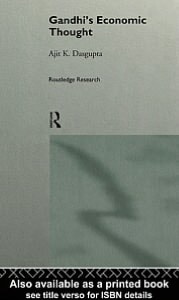
Gandhi's Economic Thought
0
0
As an Amazon Associate and affiliate partner, Menrva Books earns from qualifying purchases. Learn more
Author Description
Gandhi's economic theories were a part of his vision of self-government, which meant not just freedom from colonial rule but the achievement of self-reliance and self-respect by the villagers of India. Areas examined include:• consumption behaviour• industrialization, technology and the scale of production• trusteeship and industrial relations• work and leisure• education as human capital
Menrva's Summary
THE THESIS
This book investigates the core principles of Mahatma Gandhi's economic philosophy and its integration into his broader vision for Indian self-government. Ajit K. Dasgupta, an economist, analyzes Gandhi's writings and actions to reconstruct a coherent economic framework. He argues that Gandhian economics is not merely a rejection of modernity, but a structured approach to achieving self-reliance, dignity, and sustainable development for rural populations. The text bridges the gap between moral philosophy and practical economic policy.
THE SCOPE MAP
What You Will Find
- Analysis of consumption behavior within a decentralized, village-based economy.
- Evaluation of industrialization, appropriate technology, and small-scale production models.
- Examination of the concept of trusteeship as a mechanism for managing industrial relations and wealth.
- Exploration of the relationship between work, leisure, and the role of education as human capital.
THE AUTHORITY PERSPECTIVE
Scholars and economists frequently cite this work as a foundational text for understanding the intersection of Gandhian ethics and economic theory. Readers often note the clarity with which Dasgupta translates complex moral ideals into formal economic concepts.
Page Count:
224
Publication Date:
1996-01-01
Publisher:
Taylor & Francis, Inc.
ISBN-10:
0203463226
ISBN-13:
9780203463222
Biography
History
Philosophy
Economics
Economics
India
Community Tags
Other Editions(5)


Similar Books