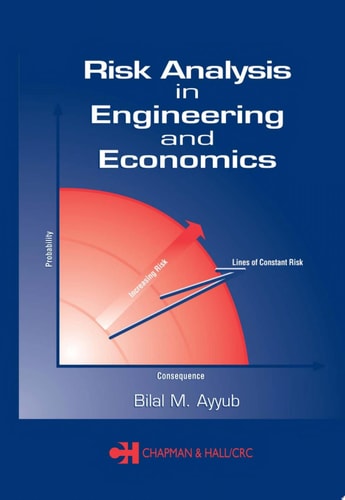
Risk Analysis in Engineering and Economics
0
0
As an Amazon Associate and affiliate partner, Menrva Books earns from qualifying purchases. Learn more
Author Description
More than any other book available, Risk Analysis in Engineering and Economics introduces the fundamental concepts, techniques, and applications of the subject in a style tailored to meet the needs of students and practitioners of engineering, science, economics, and finance. Drawing on his extensive experience in uncertainty and risk modeling and analysis, the author leads readers from the fundamental concepts through the theory, applications, and data requirements, sources, and collection. He emphasizes the practical use of the methods presented and carefully examines the limitations, advantages, and disadvantages of each. Case studies that incorporate the techniques discussed offer a practical perspective that helps readers clearly identify and solve problems encountered in practice. If you deal with decision-making under conditions of uncertainty, this book is required reading. The presentation includes more than 300 tables and figures, more than 100 examples, many case studies, and a wealth of end-of-chapter problems. Unlike the classical books on reliability and risk assessment, this book helps you relate underlying concepts to everyday applications and better prepares you to understand and use the methods of risk analysis.
Menrva's Summary
THE THESIS
This book investigates the fundamental methodologies and practical applications required to perform rigorous risk analysis within the fields of engineering, economics, and finance. Bilal M. Ayyub, an expert in uncertainty and risk modeling, synthesizes complex theoretical frameworks into an accessible guide for students and professionals. The text provides a structured approach to identifying, quantifying, and mitigating risks, emphasizing the practical utility of these models in real-world decision-making scenarios.
THE SCOPE MAP
What You Will Find
- Comprehensive coverage of uncertainty and risk modeling techniques.
- Practical applications for engineering, science, and financial sectors.
- Over 300 tables and figures illustrating core concepts.
- More than 100 worked examples and numerous end-of-chapter problems for skill reinforcement.
- Detailed case studies demonstrating the limitations and advantages of specific analytical methods.
THE AUTHORITY PERSPECTIVE
Experts and practitioners frequently identify this text as a foundational resource for bridging the gap between abstract risk theory and everyday professional application. Readers often note the extensive use of illustrative examples and data-driven case studies as particularly effective for mastering complex analytical concepts.
Page Count:
600
Publication Date:
2003-01-01
Publisher:
Taylor & Francis Group
ISBN-10:
0203497694
ISBN-13:
9780203497692
Economics
Engineering
Finance
Decision Science
Mathematics
Community Tags
Other Editions(6)


Similar Books



Reader Comments
Share Your Thoughts
No comments yet. Be the first to share your thoughts!