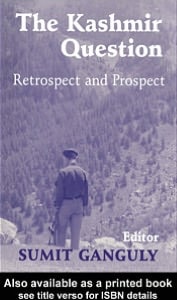
Kashmir Question Retrospect and Prospect
0
0
As an Amazon Associate and affiliate partner, Menrva Books earns from qualifying purchases. Learn more
Author Description
India, which had been created as a civic polity, initially sought to hold on to this Muslim-majority state to demonstrate its secular credentials. Pakistan, in turn, had laid claim to Kashmir because it had been created as the homeland for the Muslims of South Asia. After the break-up of Pakistan in 1971 the Pakistani irredentist claim to Kashmir lost substantial ground. If Pakistan could not cohere on the basis of religion alone it had few moral claims on its co-religionists in Kashmir. Similarly, in the 1980s, as the practice of Indian secularism was eroded, India's claim to Kashmir on the grounds of secularism largely came apart. Today their respective claims to Kashmir are mostly on the basis of statecraft. This title provides a comprehensive assessment of a number of different facets of the on-going dispute over Kashmir between India and Pakistan. Among other matters, it examines the respective endgames of both states, the evolution of American policy toward the dispute, the dangers of nuclear esculation in the region and the state of the insurgency in the Indian-controlled portion of the disputed state.
Menrva's Summary
THE THESIS
This work investigates the enduring geopolitical conflict over Kashmir, questioning how the shifting ideological foundations of India and Pakistan have transformed the dispute from a moral struggle into a matter of pragmatic statecraft. Sumit Ganguly, a recognized scholar in South Asian security studies, utilizes historical analysis and political theory to evaluate the evolution of the conflict. He examines how the erosion of secularism in India and the internal fragmentation of Pakistan have altered the legitimacy of their respective territorial claims. The text provides a rigorous framework for understanding the current impasse between the two nuclear-armed states.
THE SCOPE MAP
What You Will Find
- Analysis of the strategic endgames pursued by both India and Pakistan regarding the disputed territory.
- Evaluation of the historical evolution of United States foreign policy toward the Kashmir issue.
- Assessment of the risks associated with nuclear escalation within the South Asian region.
- Examination of the current state and operational dynamics of the insurgency within Indian-controlled Kashmir.
THE AUTHORITY PERSPECTIVE
Experts identify this text as a foundational resource for understanding the structural complexities of the Kashmir dispute. Readers frequently note the analytical clarity and the author's ability to synthesize decades of political history into a coherent geopolitical assessment.
Page Count:
220
Publication Date:
2004-01-01
Publisher:
Taylor & Francis Group
ISBN-10:
020350416X
ISBN-13:
9780203504161
History
Geopolitics
International relations
Politics & Government
India
Community Tags
Similar Books