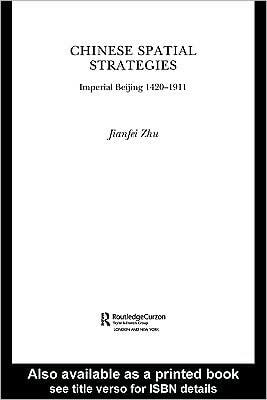
Chinese Spatial Strategies: Imperial Beijing, 1420-1911
0
0
As an Amazon Associate and affiliate partner, Menrva Books earns from qualifying purchases. Learn more
Author Description
Presents a study of social spaces of the capital of Ming Qing China (1420-1911). Focusing on early Ming and early and middle Qing, it explores architectural, urban and geographical space of Beijing.
Menrva's Summary
THE THESIS
This work investigates how the spatial configuration of Beijing served as a physical manifestation of imperial power and social hierarchy during the Ming and Qing dynasties. Jianfei Zhu, an expert in architectural theory and urban history, utilizes a combination of historical records, cartographic analysis, and architectural theory to deconstruct the capital's layout. He argues that the city was not merely a static environment but a dynamic instrument of governance that reinforced the ideological structures of the Chinese imperial state.
THE SCOPE MAP
What You Will Find
- Analysis of the urban planning and architectural evolution of Beijing from 1420 to 1911.
- Examination of the relationship between social space and imperial authority in Ming and Qing China.
- Integration of historical geography and architectural theory to interpret urban design.
- Case studies focusing on the early Ming and early-to-middle Qing periods.
THE AUTHORITY PERSPECTIVE
Scholars and urban historians frequently cite this text as a rigorous examination of the intersection between political ideology and urban form. Readers often note the academic density of the prose, which provides a specialized framework for understanding the symbolic landscape of the imperial capital.
Page Count:
296
Publication Date:
2004-01-01
Publisher:
Taylor & Francis Group
ISBN-10:
0203613481
ISBN-13:
9780203613481
History
Architecture
Architecture china
China
urban planning
Community Tags
Similar Books