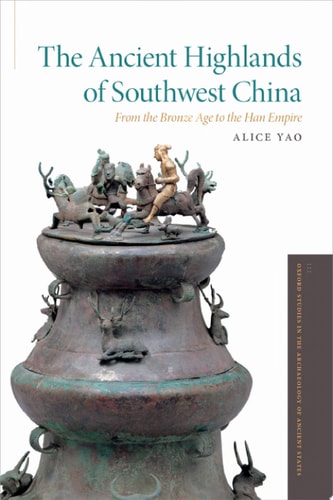
The Ancient Highlands of Southwest China: From the Bronze Age to the Han Empire
0
0
As an Amazon Associate and affiliate partner, Menrva Books earns from qualifying purchases. Learn more
Author Description
Although long considered to be a barren region on the periphery of ancient Chinese civilization, the southwest massif was once the political heartland of numerous Bronze Age polities. Their distinctive material tradition--intricately cast bronze kettle drums and cowrie shell containers--has given archaeologists and historians a glimpse of the extraordinary wealth, artistry, and power exercised by highland leaders over the course of the first millennium BC. In the first century BC, Han imperial conquest reduced local power and began a process of cultural assimilation.Instead of a clash between center and periphery or barbarism and civilization, this book examines the classic study of imperial rule as a confrontation between different political temporalities. The author provides an archaeological account of the southwest where Bronze Age landscape formations and funerary traditions bring to light a history of competing warrior cultures and kingly genealogies. In particular, the book illustrates how mourners used funerals and cemetery mounds to transmit social biographies and tribal affiliations across successive generations. Han incorporation thus entangled the orders of state time with the generational cycles of local factions, foregrounding the role of time in the production of power relations in imperial frontiers. The book extends approaches to empires to show how prehistoric time frames continue to shape the futures of frontier subjects despite imperial efforts to unify space and histories.
Menrva's Summary
THE THESIS
This book investigates how the southwest massif of China transitioned from a collection of independent Bronze Age polities to a territory integrated into the Han Empire. Alice Yao, an expert in Chinese archaeology, utilizes archaeological evidence from funerary sites and material culture to challenge traditional narratives of imperial expansion. She argues that the confrontation between the Han state and local highland populations was fundamentally a conflict of differing political temporalities rather than a simple binary of civilization versus barbarism.
THE SCOPE MAP
What You Will Find
- Analysis of Bronze Age material culture, specifically kettle drums and cowrie shell containers.
- Examination of funerary traditions and cemetery mounds as tools for social identity.
- Theoretical framework regarding the intersection of state time and generational cycles.
Scope Limits
- The study focuses specifically on the southwest massif region rather than the entirety of the Han frontier.
- The analysis does not provide a comprehensive military history of the Han conquest.
THE AUTHORITY PERSPECTIVE
Scholars in the field of East Asian archaeology recognize this work as a sophisticated contribution to the study of imperial frontiers and political time. Readers frequently note the academic density of the prose, which is tailored for researchers and students of ancient state formation.
Page Count:
282
Publication Date:
2016-01-01
Publisher:
Oxford University Press
ISBN-10:
0190493798
ISBN-13:
9780190493790
History
China
Anthropology
Archaeology
Bronze Age
Asian History
Humanities
Han Empire
Community Tags
Similar Books