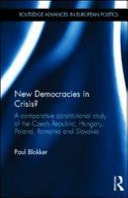
New Democracies in Crisis?: A Comparative Constitutional Study of the Czech Republic, Hungary, Poland, Romania and Slovakia
0
0
As an Amazon Associate and affiliate partner, Menrva Books earns from qualifying purchases. Learn more
Author Description
This Book Considers Whether The Potential Of Democracy Following The End Of The Cold War Was Diminished By Technocratic, Judicial Control Of Politics In The New Democracies Of Central And Eastern Europe. It Explores The Complexities And Drawbacks Of Modern Constitutionalism By Offering A Comprehensive Theoretical And Comparative-empirical Assessment Of The Status And Role Of Constitutionalism In Five New Eu Member States. The Democratization Of Countries In Central And Eastern Europe Has Been Guarded By Constitutions And Constitutional Courts. This Book Examines The Implications Of Powerful Courts And Rigid Constitutions For The Democratic Engagement Of Citizens And The Political Authority Of Politicians. Using An Interdisciplinary And Comparative Approach, The Book Analyses The Historical Emergence Of Powerful Constitutional Institutions In The Czech Republic, Hungary, Poland, Romania And Slovakia. The Author Argues That The Democratic Promise Of 1989 Largely Lost Out To A Technocratic And Top-down View Of Judicial Control Of Politics - A State Of Affairs Reinforced By Eu Accession. The Current Backlash In Countries Such As Hungary And Romania Indicates That The Realization Of Democratization To The Extent Initially Expected Might Be Ever More Remote In Some New Democracies. New Democracies In Crisis? Will Be Of Interest To Students And Scholars Of European Union Politics, Democratization Studies, European Constitutionalism, Socio-legal Studies, Governance And Comparative Politics.
Menrva's Summary
THE THESIS
This book investigates whether the democratic potential of post-Cold War Central and Eastern Europe was undermined by the rise of technocratic, judicial control over political processes. Paul Blokker, a scholar specializing in socio-legal studies and democratization, utilizes a comparative-empirical framework to assess the role of constitutionalism in five specific EU member states. He argues that the initial democratic promise of 1989 was constrained by a top-down, judicialized approach to governance, a trend further solidified by the requirements of European Union accession. The text evaluates how this institutional rigidity has contributed to contemporary political backlashes and democratic instability in the region.
THE SCOPE MAP
What You Will Find
- Comparative analysis of constitutional institutions in the Czech Republic, Hungary, Poland, Romania, and Slovakia.
- Theoretical assessment of the tension between judicial review and democratic political authority.
- Examination of the impact of European Union accession on national governance structures.
- Historical investigation into the emergence of constitutional courts as primary political actors in post-communist states.
THE AUTHORITY PERSPECTIVE
Scholars in the fields of European politics and constitutional law identify this work as a critical examination of the institutional challenges facing post-1989 democracies. Readers frequently note the academic density of the prose and the author's rigorous interdisciplinary approach to complex socio-legal phenomena.
Page Count:
200
Publication Date:
2013-01-01
Publisher:
Taylor & Francis Group
ISBN-10:
0203795024
ISBN-13:
9780203795026
History
Governance
Constitutional Law
Europe central
Community Tags
Similar Books