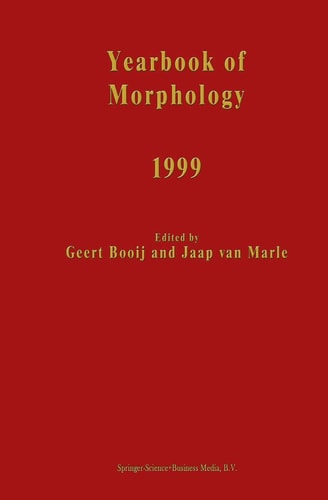
Yearbook of Morphology 1999
0
0
As an Amazon Associate and affiliate partner, Menrva Books earns from qualifying purchases. Learn more
Author Description
A revival of interest in morphology has occurred during recent years. The Yearbook of Morphology series, published since 1988, has proven to be an eminent support for this upswing of morphological research, since it contains articles on topics which are central in the current theoretical debates which are frequently referred to. The Yearbook of Morphology 1999 focuses on diachronic morphology, and shows, in a number of articles by renowned specialists, how complicated morphological systems develop in the course of time. In addition, this volume deals with a number of hotly debated issues in theoretical morphology: its interaction with phonology (including Optimality Theory), the relation between inflection and word formation, and the formal modeling of inflectional systems. A special feature of this volume is an article on morphology in sign language, a very new and exciting area of research in linguistics. The relevant evidence comes from a wide variety of languages, amongst which Germanic, Romance, and Slavic languages are prominent. Audience: Theoretical, descriptive, and historical linguists, morphologists, phonologists, and psycholinguists will find this book of interest.
Menrva's Summary
THE THESIS
The Yearbook of Morphology 1999 investigates the complex development of morphological systems over time and addresses current debates in theoretical morphology. This volume, part of a series supporting the resurgence of morphological research, features articles by specialists on diachronic morphology, exploring how languages evolve. It also delves into critical issues such as the interplay between morphology and phonology, including Optimality Theory, the relationship between inflection and word formation, and the formal modeling of inflectional systems. A unique contribution is an article on morphology in sign language, highlighting a novel area of linguistic inquiry, with evidence drawn from a diverse range of languages including Germanic, Romance, and Slavic.
THE SCOPE MAP
- Focus on diachronic morphology and the evolution of morphological systems.
- Exploration of interactions between morphology and phonology, including Optimality Theory.
- Discussion on the relationship between inflection and word formation.
- Analysis of formal modeling for inflectional systems.
- An article dedicated to morphology in sign language.
- Evidence drawn from Germanic, Romance, and Slavic languages.
THE AUTHORITY PERSPECTIVE
This volume is of interest to theoretical, descriptive, and historical linguists, morphologists, phonologists, and psycholinguists. The collection addresses central topics in current theoretical debates within morphology, making it a frequently referenced resource. Its focus on diachronic aspects and contemporary theoretical issues, alongside a novel look at sign language morphology, positions it as a valuable contribution to the field. The diverse linguistic evidence presented ensures broad relevance for specialists across various sub-disciplines of linguistics.
Page Count:
321
Publication Date:
2010-12-04
Publisher:
Springer Netherlands
ISBN-10:
9048155827
ISBN-13:
9789048155828
Non-Fiction
Science
Sign language
Morphology
Phonology
Theoretical Linguistics
Linguistics
Community Tags
Similar Books