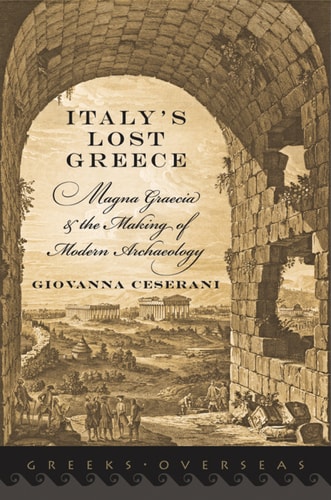
Italy's Lost Greece: Magna Graecia and the Making of Modern Archaeology
0
0
As an Amazon Associate and affiliate partner, Menrva Books earns from qualifying purchases. Learn more
Author Description
Italy's Lost Greece is the untold story of the modern engagement with the ancient Greek settlements of South Italy--an area known since antiquity as Magna Graecia. This "Greater Greece," at once Greek and Italian, has continuously been perceived as a region in decline since its archaic golden age, and has long been relegated to the margins of classical studies. Giovanna Ceserani's evocative and nuanced analysis recovers its significance within the history of classical archaeology. It was here that the Renaissance first encountered an ancient Greek landscape, and during the "Hellenic turn" of eighteenth-century Europe the temples of Paestum and the painted vases of South Italy played major roles, but since then, Magna Graecia--lying outside the national boundaries of modern Greece, and sharing in the complicated regional dynamic of the Italian Mezzogiorno--has fitted awkwardly into the commonly accepted paradigms of Hellenism. The unfolding of this process provides a unique insight into three developments: the humanist investment in the ancient past, the evolution of modern Hellenism, and the making of classical archaeology. Drawing on antiquarian and archaeological writings, histories and travelogues about Magna Graecia, and recent rewritings of the history and imagining of the South, Italy's Lost Greece sheds new light on well known figures in the history of archaeology while recovering forgotten ones. This is an Italian story of European resonance, which transforms our understanding of the transition from antiquarianism to archaeology, of the relationship between nation-making and institution-building in the study of the ancient past, and of the reconstruction of classical Greece in the modern world.
Menrva's Summary
THE THESIS
This book investigates how the ancient Greek settlements of Southern Italy, known as Magna Graecia, were marginalized in classical studies and how their rediscovery shaped the development of modern archaeology. Giovanna Ceserani, a scholar of classical history, examines the intellectual and cultural history of this region from the Renaissance through the eighteenth-century Hellenic turn. By analyzing travelogues, antiquarian writings, and historical narratives, she argues that the perception of Magna Graecia as a region in decline reflects broader European tensions regarding nation-building and the definition of Hellenism. The work provides a framework for understanding how the study of the ancient past is inextricably linked to the political and cultural priorities of the modern era.
THE SCOPE MAP
What You Will Find
- Analysis of the intellectual history of Magna Graecia from the Renaissance to the modern era
- Examination of the transition from antiquarianism to professional archaeology
- Case studies on the impact of Paestum temples and South Italian painted vases on European thought
- Discussion of the intersection between regional Italian identity and classical scholarship
Scope Limits
- The text does not provide a comprehensive archaeological survey or site-by-site excavation report of the region
- It does not focus on the prehistoric or indigenous pre-Greek cultures of the Italian peninsula
THE AUTHORITY PERSPECTIVE
Scholars and historians of classical archaeology frequently cite this work for its rigorous analysis of the historiography surrounding Mediterranean studies. Readers note that the prose is academically dense and requires a foundational knowledge of European intellectual history to fully appreciate the author's arguments.
Page Count:
347
Publication Date:
2012-01-01
Publisher:
Oxford University Press
ISBN-10:
0190453966
ISBN-13:
9780190453961
History
Humanities
Hellenism
Italy
Ancient History
Archaeology
European History
Community Tags
Similar Books