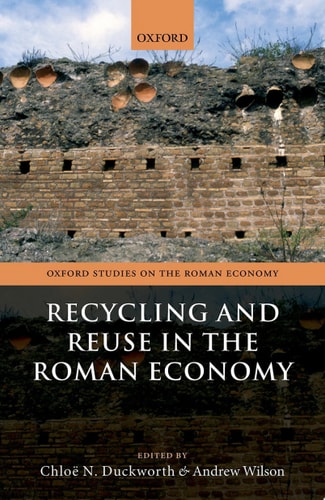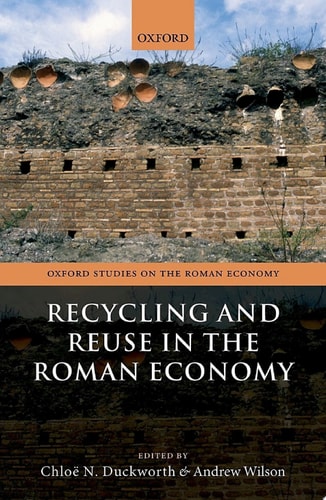
Recycling and Reuse in the Roman Economy
0
0
As an Amazon Associate and affiliate partner, Menrva Books earns from qualifying purchases. Learn more
Author Description
The recycling and reuse of materials and objects were extensive in the past, but have rarely been embedded into models of the economy; even more rarely has any attempt been made to address the scale of these practices. Recent developments, including the use of large datasets, computational modelling, and high-resolution analytical chemistry are increasingly offering the means to reconstruct recycling and reuse, and even to approach the thorny issue of quantification. This volume is the first to bring together these new approaches, and the first to present a consideration of recycling and reuse in the Roman economy, taking into account a range of materials and using a variety of methodological approaches. It presents integrated, cross-referential evidence for the recycling and reuse of textiles, papyrus, statuary and building materials, amphorae, metals, and glass, and examines significant questions about organization, value, and the social meaning of recycling.
Menrva's Summary
THE THESIS
This volume investigates the extent and economic significance of material recycling and reuse within the Roman Empire. Editors Andrew Wilson and Chloë N. Duckworth, both established scholars in Roman archaeology and material science, synthesize recent advancements in computational modeling and analytical chemistry to address the historical neglect of circular economic practices. The work argues that recycling was not merely a survival strategy but a structured component of Roman economic life that can now be quantified through interdisciplinary evidence.
THE SCOPE MAP
What You Will Find
- Analysis of textiles, papyrus, statuary, building materials, amphorae, metals, and glass.
- Methodologies involving high-resolution analytical chemistry and computational modeling.
- Cross-referential case studies examining the organization and social meaning of material recovery.
Scope Limits
- The text focuses primarily on the Roman period and does not provide a comprehensive history of recycling in other ancient civilizations.
- It does not offer a universal economic model but rather a collection of specific material-based studies.
THE AUTHORITY PERSPECTIVE
Experts identify this volume as a foundational text for integrating material science into the study of ancient economic history. Scholars frequently note the academic density of the prose and the rigorous methodological approach applied to previously under-researched economic sectors.
Page Count:
512
Publication Date:
2020-01-01
Publisher:
OUP Oxford
ISBN-10:
0192604872
ISBN-13:
9780192604873
Economics
History
Economics history
Archaeology
Ancient History
Roman History