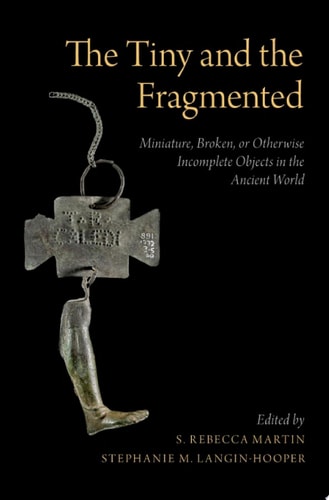
The Tiny and the Fragmented: Miniature, Broken, or Otherwise Incomplete Objects in the Ancient World
0
0
As an Amazon Associate and affiliate partner, Menrva Books earns from qualifying purchases. Learn more
Author Description
Miniature and fragmentary objects are both eye-catching and yet easily dismissed. Tiny scale entices users with visions of Lilliputian worlds. The ambiguity of fragments intrigues us, offering tactile reminders of reality's transience. Yet, the standard scholarly approach to such objects has been to see them as secondary, incomplete things, whose principal purpose was to refer to a complete and often life-size whole.The Tiny and the Fragmented offers a series of fresh perspectives on the familiar concepts of the tiny and the fragmented. Written by a prestigious group of internationally-acclaimed scholars, the volume presents a remarkable diversity of case studies that range from Neolithic Europe to pre-Colombian Honduras to the classical Mediterranean and ancient Near East. Each scholar takes a different approach to issues of miniaturization and fragmentation but is united in considering the little and broken things of the past as objects in their own right. Whether a life-size or whole thing is made in a scaled-down form, deliberately broken as part of its use, or only considered successful in the eyes of ancient users if it shows some signs of wear, it challenges our expectations of representation and wholeness, of what it means for a work of art to be "finished" and "affective." Overall, The Tiny and the Fragmented demands a reconsideration of the social and contextual nature of miniaturization, fragmentation, and incompleteness, making the case that it was because of, rather than in spite of, their small or partial state that these objects were valued parts of the personal and social worlds they inhabited.
Menrva's Summary
THE THESIS
This volume investigates the cultural and social significance of miniature and fragmentary objects in ancient societies, challenging the traditional scholarly view that such items are merely incomplete representations of larger wholes. Editors S. Rebecca Martin and Stephanie M. Langin-Hooper curate a collection of essays from international scholars who argue that small or broken objects functioned as intentional, meaningful artifacts within their original contexts. By analyzing these items as autonomous entities rather than secondary remnants, the contributors propose a new framework for understanding how ancient users perceived value, completeness, and artistic efficacy.
THE SCOPE MAP
What You Will Find
- Comparative analysis of miniaturization and fragmentation across diverse ancient cultures.
- Case studies spanning Neolithic Europe, pre-Colombian Honduras, the classical Mediterranean, and the ancient Near East.
- Theoretical discussions on the definition of 'finished' and 'affective' art in antiquity.
Scope Limits
- The text does not provide a comprehensive catalog of all known miniature or fragmented artifacts from the ancient world.
- It does not focus on modern conservation or restoration techniques for these specific object types.
THE AUTHORITY PERSPECTIVE
Scholars and archaeologists recognize this volume as a significant contribution to material culture studies, particularly for its shift in focus toward the intentionality of incomplete objects. Readers frequently note the academic density of the prose, which serves as a foundational text for students and researchers interested in the intersection of art history and archaeology.
Page Count:
248
Publication Date:
2018-01-01
Publisher:
Oxford University Press
ISBN-10:
0190910828
ISBN-13:
9780190910822
History
Ancient History
Humanities
Art History
Minimal Art
Art Ancient
Anthropology
Archaeology
Community Tags
Similar Books