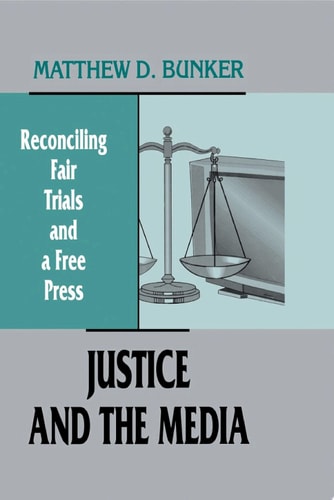
Justice and the Media
0
0
As an Amazon Associate and affiliate partner, Menrva Books earns from qualifying purchases. Learn more
Author Description
The First Amendment Right of free speech is a fragile one. Its fragility is found no less in legal opinions than in no other specialized forms of public discourse. Both its fragility and its sometimes surprising resiliency are reflected in this book. It provides an examination of how the U.S. Supreme Court has dealt with the problem of restrictions on media coverage of the criminal justice system, as well as how lower courts have interpreted the law created by the Supreme Court. The author explores the degree to which the Court has created a coherent body of law that protects free expression values while permitting reasonable government regulation, and examines the Supreme Court's jurisprudence concerning prior restraints, postpublication sanctions on the press, and their right of access to criminal proceedings.
Menrva's Summary
THE THESIS
This book investigates the tension between First Amendment free speech protections and the government's authority to regulate media coverage of the criminal justice system. Matthew D. Bunker, a scholar of communication law, analyzes the consistency and evolution of U.S. Supreme Court jurisprudence regarding the press. He evaluates whether the judiciary has successfully balanced the protection of free expression values against the practical requirements of government regulation in legal proceedings.
THE SCOPE MAP
What You Will Find
- Analysis of U.S. Supreme Court jurisprudence regarding media access to criminal proceedings.
- Examination of legal standards for prior restraints and postpublication sanctions on the press.
- Evaluation of how lower courts interpret and apply Supreme Court precedents.
- Discussion of the coherence of First Amendment law in the context of public discourse.
THE AUTHORITY PERSPECTIVE
Legal scholars and students of media law frequently cite this text for its focused analysis of the intersection between constitutional rights and judicial oversight. Experts highlight the book as a useful resource for understanding the complexities of media access and the limitations placed on the press within the American criminal justice system.
Page Count:
0
Publication Date:
2013-01-01
Publisher:
Taylor & Francis Group
ISBN-10:
0203812689
ISBN-13:
9780203812686
Non-Fiction
Pressefreiheit
United States
Law
Fair Trial
Freedom of speech
Media Studies
Freedom of the press