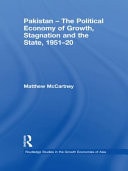
Pakistan: The Political Economy of Growth, Stagnation and the State, 1951-2009
0
0
As an Amazon Associate and affiliate partner, Menrva Books earns from qualifying purchases. Learn more
Author Description
This Book Provides A Comprehensive Reassessment Of The Development Of The Economy Of Pakistan Since Independence To The Present. It Employs A Rigorous Statistical Methodology, Which Has Applicability To Other Developing Economies, To Define And Measure Episodes Of Growth And Stagnation, And To Examine How The State Has Contributed To Each. Contesting The Orthodox View That Liberalisation Has Been An Important Driver Of Growth In Pakistan, The Book Places The State At The Centre Of Economic Development, Rather Than The Market. It Examines The State In Relation To Its Economic Roles In Mobilising Resources And Promoting A Productive Allocation Of Those Resources, And Its Political Roles In Managing The Conflict Inherent In Economic Development. The Big Conclusions For Economic Growth In Pakistan Are That Liberalisation, The Market And The External World Economy In Fact Have Less Influence Than That Of The State And Conflict. Overall, The Book Offers Analyses Of The Different Successive Approaches To Promoting Economic Growth And Development In Pakistan, Relates These To Medium-term Economic Outcomes - Periods Of Growth And Stagnation - And Thereby Explains How The Mechanisms By Which The State Can Better Promote Growth And Development.
Menrva's Summary
THE THESIS
This book investigates the primary drivers of economic growth and stagnation in Pakistan from 1951 to 2009, challenging the prevailing orthodoxy that market liberalization is the primary engine of development. Matthew McCartney, a scholar specializing in development economics, utilizes a rigorous statistical framework to evaluate the role of the state in resource mobilization and conflict management. By analyzing historical economic episodes, the author argues that the state, rather than external market forces, remains the central actor in determining long-term economic outcomes.
THE SCOPE MAP
What You Will Find
- A methodological critique of existing growth models applied to developing nations.
- A detailed chronological analysis of growth and stagnation episodes in Pakistan from 1951 to 2009.
- An examination of the state's political role in managing internal conflict and resource allocation.
- Comparative data sets contrasting liberalized economic policies against state-led development strategies.
THE AUTHORITY PERSPECTIVE
Experts recognize this work as a significant contribution to the political economy of South Asia, particularly for its departure from standard neoliberal interpretations. Readers frequently note the academic density of the prose, which makes it a foundational text for students and researchers interested in state-centric development models.
Page Count:
264
Publication Date:
2011-01-01
Publisher:
Taylor & Francis Group
ISBN-10:
0203814762
ISBN-13:
9780203814765
History
Economics
Pakistan
Community Tags
Similar Books