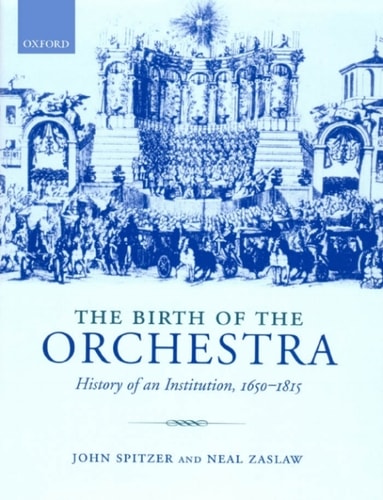
The Birth of the Orchestra: History of an Institution, 1650-1815
0
0
As an Amazon Associate and affiliate partner, Menrva Books earns from qualifying purchases. Learn more
Author Description
This book traces the emergence of the orchestra from 16th-century string bands to the 'classical' orchestra of Haydn, Mozart, Beethoven, and their contemporaries. Ensembles of bowed stringed instruments, several players per part plus continuo and wind instruments, were organized in France in the mid-17th century and then in Rome at the end of the century. The prestige of these ensembles and of the music and performing styles of their leaders, Jean-Baptiste Lully and Arcangelo Corelli, caused them to be imitated elsewhere, until by the late 18th century, the orchestra had become a pan-European phenomenon. Spitzer and Zaslaw review previous accounts of these developments, then proceed to a thoroughgoing documentation and discussion of orchestral organization, instrumentation, and social roles in France, Italy, Germany, England, and the American colonies. They also examine the emergence of orchestra musicians, idiomatic music for orchestras, orchestral performance practices, and the awareness of the orchestra as a central institution in European life.
Menrva's Summary
THE THESIS
This book investigates the origins and institutional development of the orchestra as a central musical entity between 1650 and 1815. John Spitzer and Neal Zaslaw, both established musicologists, utilize extensive archival documentation and historical performance records to challenge previous narratives regarding the orchestra's evolution. They argue that the orchestra emerged not as a sudden invention, but as a gradual, pan-European phenomenon driven by the prestige of specific French and Italian ensembles and their leaders.
THE SCOPE MAP
What You Will Find
- Detailed documentation of orchestral organization and instrumentation from 1650 to 1815
- Analysis of the social roles and professionalization of orchestral musicians
- Comparative studies of musical practices across France, Italy, Germany, England, and the American colonies
- Examination of the influence of Jean-Baptiste Lully and Arcangelo Corelli on performance styles
Scope Limits
- The study concludes at 1815, excluding the expansion and transformation of the orchestra during the late 19th and 20th centuries
- Does not provide a comprehensive history of individual orchestral compositions, focusing instead on the institution itself
THE AUTHORITY PERSPECTIVE
Experts recognize this work as a foundational text for understanding the structural and social history of the classical orchestra. Scholars frequently cite the authors' rigorous use of primary sources and their systematic approach to documenting the institutionalization of musical ensembles.
Page Count:
640
Publication Date:
2004-01-01
Publisher:
OUP Oxford
ISBN-10:
0191513237
ISBN-13:
9780191513237
Humanities
Music History
European History
Musicology
Criticism history
Community Tags
Similar Books