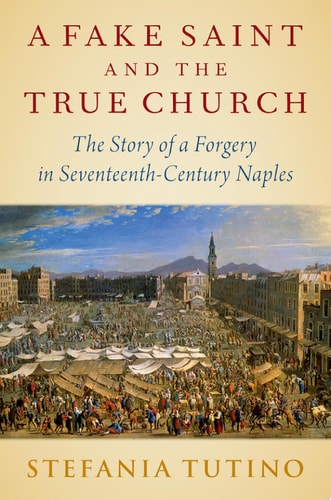
A Fake Saint and the True Church: The Story of a Forgery in Seventeenth-Century Naples
0
0
As an Amazon Associate and affiliate partner, Menrva Books earns from qualifying purchases. Learn more
Author Description
A Fake Saint and the True Church uncovers the remarkable story of a fake saint to tell a tale about truth. It begins at the end of the 1650s, when a large quantity of forged documents suddenly appeared throughout the Kingdom of Naples. Narrating the life and deeds of a previously unknown medieval saint named Giovanni Calà, the trove generated much excitement around the kingdom. No one was more delighted by the news than Carlo Calà, Giovanni's wealthy and politically influential seventeenth-century descendant. Attracted by the prospect of adding a saint to the family tree, Carlo presented Giovanni's case to the Roman Curia. The Catholic authorities, however, immediately realized that the sources were forged, and that Giovanni was not real (let alone holy). Yet, it took more than two decades before the forgery was exposed: why?Vividly reconstructing the intricate case of the supposed saint, Stefania Tutino explores the tensions between historical and theological truth. How much could the truth of doctrine depend on the truth of the facts before religion lost its connection with the supernatural? To what extent could the truth of doctrine ignore the truth of the facts without ending up engulfed in falsity and deceit? How could the absolute truth of theology relate to the far less absolute certainty of human affairs? This story of a fake saint illuminates early modern tensions. But the struggles to distinguish between facts, opinions, and beliefs remain with us. Examining, as this book does, how our predecessors dealt with the relationship between truth and authenticity guides us too in thinking through what is true and what is not.
Menrva's Summary
THE THESIS
This book investigates the complex relationship between historical fact and theological doctrine by analyzing a seventeenth-century forgery case in the Kingdom of Naples. Stefania Tutino, a scholar of early modern history and religion, utilizes archival records and legal proceedings to examine how the Roman Curia and local nobility navigated the discovery of a fabricated saint. The work argues that the delay in exposing the forgery reveals deep-seated tensions regarding how religious institutions reconcile absolute theological truths with the fallible nature of human evidence and historical documentation.
THE SCOPE MAP
What You Will Find
- A detailed reconstruction of the 1650s forgery involving the fictional saint Giovanni Calà.
- An analysis of the political and social motivations of the Calà family in promoting a false saint.
- Examination of the Roman Curia's investigative methodologies and evidentiary standards.
- A philosophical inquiry into the distinction between historical truth, theological doctrine, and religious authenticity.
THE AUTHORITY PERSPECTIVE
Experts highlight this work as a rigorous contribution to the study of early modern intellectual history and the evolution of historical criticism. Readers frequently note the academic density of the prose, which effectively bridges the gap between microhistory and broader theological discourse.
Page Count:
203
Publication Date:
2021-01-01
Publisher:
Oxford University Press
ISBN-10:
0197578829
ISBN-13:
9780197578827
History
Religion
Theology
HistoryCatholic Church
Christian History
European History
Forgery of manuscripts--History
Canonization
Italy
Doctrines
Religious History
History of the Americas
Community Tags
Similar Books