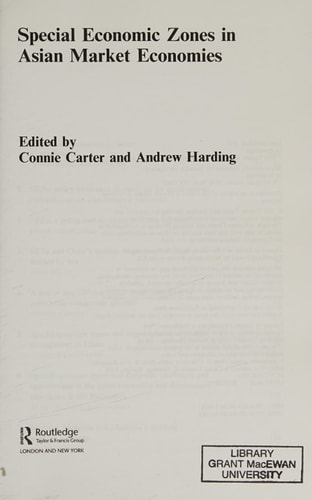
Special economic zones in Asian market economies
0
0
As an Amazon Associate and affiliate partner, Menrva Books earns from qualifying purchases. Learn more
Author Description
Special Economic Zones (SEZs) have proliferated rapidly during the past decade and are set to multiply in the next – embracing not only Asia and Europe but also Africa and the Americas. This book is the first to examine the Asian experience of SEZs in China, India, Malaysia and the Philippines. SEZs are usually clearly defined geographic areas in which national, provincial or local governments use policy tools (such as tax holidays; improved infrastructure; less onerous or differentiated regulations and incentives other than those generally available in the rest of the country) to attract and promote private - usually foreign - investment from enterprises which commit to create employment and to export their products or services, and generating foreign currency for the host country. SEZs have been especially successful in bringing about economic development in Asia, especially in China.This book examines the origins, nature and status of special economic zones in Asia, together with the current trends connected with them, and the challenges they currently face. Although the World Trade Organisation cast doubts in 1995 on the future of special economic zones as a viable policy tool in the development agenda, special economic zones continue to be used, and favoured, as a way of encouraging foreign investment and economic development, with for example India, trying to emulate China, reincorporating special economic zones into its development policy. This book provides regional case studies of SEZs in Asian market economies to analyse the extent to which these zones serve the changing needs of Asian development.
Menrva's Summary
THE THESIS
This book investigates the efficacy and evolution of Special Economic Zones (SEZs) as strategic policy instruments for fostering economic development within Asian market economies. Connie Carter, an expert in international business and law, utilizes a comparative framework to evaluate how specific nations leverage tax incentives, infrastructure investment, and regulatory differentiation to attract foreign direct investment. The text argues that despite skepticism from global trade organizations, SEZs remain a central, albeit evolving, component of national development agendas in the region.
THE SCOPE MAP
What You Will Find
- Comparative analysis of SEZ implementation in China, India, Malaysia, and the Philippines.
- Examination of the policy tools used to incentivize private and foreign investment.
- Historical context regarding the 1995 World Trade Organisation stance on SEZs.
- Assessment of the challenges and future trends facing SEZs in a globalized market.
THE AUTHORITY PERSPECTIVE
Experts recognize this work as a foundational comparative study for understanding the mechanics of Asian economic zones. Readers frequently note the academic density of the prose, which provides a rigorous examination of regional policy shifts and development outcomes.
Page Count:
208
Publication Date:
2010-01-01
Publisher:
Routledge
ISBN-10:
0203841867
ISBN-13:
9780203841860
Business
Economics
Public Policy
International Trade
Asian Studies