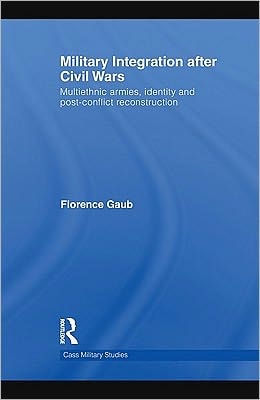
Military Integration After Civil Wars: Multiethnic Armies, Identity, and Post-Conflict Reconstruction
0
0
As an Amazon Associate and affiliate partner, Menrva Books earns from qualifying purchases. Learn more
Author Description
This book examines the role of multiethnic armies in post-conflict reconstruction, and demonstrates how they can promote peacebuilding efforts.The author challenges the assumption that multiethnic composition leads to weakness of the military, and shows how a multiethnic army is frequently the impetus for peacemaking in multiethnic societies. Three case studies (Nigeria, Lebanon and Bosnia-Herzegovina) determine that rather than external factors, it is the internal structures that make or break the military institution in a socially challenging environment. The book finds that where the political will is present, the multiethnic military can become a symbol of reconciliation and coexistence. Furthermore, it shows that the military as a professional identity can supersede ethnic considerations and thus facilitates cooperation within the armed forces despite a hostile post-conflict setting. In this, the book challenges widespread theories about ethnic identities and puts professional identities on an equal footing with them.The book will be of great interest to students of military studies, ethnic conflict, conflict studies and peacebuilding, and IR in generalFlorence Gaub is a Researcher and Lecturer at the NATO Defence College in Rome. She holds a PhD in International Politics from Humboldt University, Berlin.
Menrva's Summary
THE THESIS
This book investigates whether multiethnic armies serve as a stabilizing force or a point of failure during post-conflict reconstruction. Florence Gaub, a researcher at the NATO Defence College, utilizes a comparative analysis of three distinct post-conflict nations to challenge the prevailing assumption that ethnic diversity inherently weakens military cohesion. She argues that internal institutional structures, rather than external pressures, determine the success of these forces in fostering national reconciliation.
THE SCOPE MAP
What You Will Find
- Comparative case studies of Nigeria, Lebanon, and Bosnia-Herzegovina.
- Analysis of the interplay between professional military identity and ethnic identity.
- Examination of institutional design as a mechanism for peacebuilding.
- Evaluation of political will as a prerequisite for military integration.
THE AUTHORITY PERSPECTIVE
Experts in international relations and security studies identify this work as a significant contribution to the literature on post-conflict state-building. Readers frequently note the academic rigor of the comparative methodology and the clarity with which the author addresses complex institutional dynamics.
Page Count:
192
Publication Date:
2010-01-01
Publisher:
Routledge
ISBN-10:
0203841050
ISBN-13:
9780203841051
Armed Forces
Sociology
International relations
Military Studies
Conflict Studies
Peacebuilding
Civil War
Community Tags
Similar Books