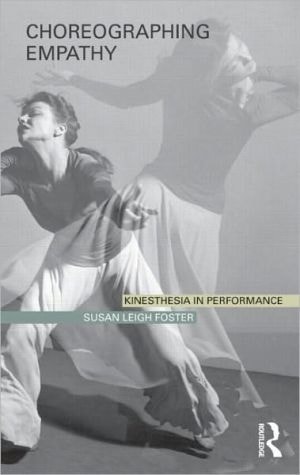
Choreographing Empathy: Kinesthesia in Performance
0
0
As an Amazon Associate and affiliate partner, Menrva Books earns from qualifying purchases. Learn more
Author Description
"This is an urgently needed book – as the question of choreographing behavior enters into realms outside of the aesthetic domains of theatrical dance, Susan Foster writes a thoroughly compelling argument." – André Lepecki, New York University"May well prove to be one of Susan Foster’s most important works." – Ramsay Burt, De Montford University, UKWhat do we feel when we watch dancing? Do we "dance along" inwardly? Do we sense what the dancer’s body is feeling? Do we imagine what it might feel like to perform those same moves? If we do, how do these responses influence how we experience dancing and how we derive significance from it?Choreographing Empathy challenges the idea of a direct psychophysical connection between the body of a dancer and that of their observer. In this groundbreaking investigation, Susan Foster argues that the connection is in fact highly mediated and influenced by ever-changing sociocultural mores.Foster examines the relationships between three central components in the experience of watching a dance – the choreography, the kinesthetic sensations it puts forward, and the empathetic connection that it proposes to viewers. Tracing the changing definitions of choreography, kinesthesia, and empathy from the 1700s to the present day, she shows how the observation, study, and discussion of dance have changed over time. Understanding this development is key to understanding corporeality and its involvement in the body politic.
Menrva's Summary
THE THESIS
This book investigates the complex, mediated relationship between the physical movements of a dancer and the empathetic responses of an observer. Susan A. Foster, a prominent scholar in dance studies, utilizes historical analysis and performance theory to challenge the assumption of a direct, universal psychophysical connection between performer and audience. She argues that these responses are not innate but are instead constructed and filtered through shifting sociocultural norms and historical contexts.
THE SCOPE MAP
What You Will Find
- Historical analysis of the definitions of choreography, kinesthesia, and empathy from the 18th century to the present.
- A theoretical framework examining the intersection of corporeality and the body politic.
- Examination of how sociocultural mores influence the perception of movement.
- Critical inquiry into the mechanics of audience engagement and the derivation of meaning in performance.
THE AUTHORITY PERSPECTIVE
Scholars in the field of performance studies identify this work as a significant contribution to the understanding of somatic experience and spectatorship. Readers frequently note the academic rigor and the depth of the historical research presented throughout the text.
Page Count:
296
Publication Date:
2010-01-01
Publisher:
Taylor & Francis Group
ISBN-10:
0203840704
ISBN-13:
9780203840702
Philosophy
Choreography
Performance Studies
Sociology
Dance
Community Tags
Similar Books