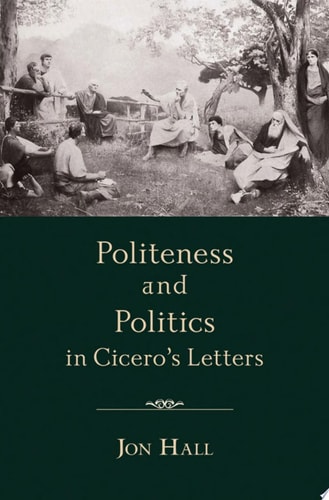
Politeness and Politics in Cicero's Letters
0
0
As an Amazon Associate and affiliate partner, Menrva Books earns from qualifying purchases. Learn more
Author Description
Politeness and Politics in Cicero's Letters presents a fresh examination of the letters exchanged between Cicero and correspondents, such as Pompey, Julius Caesar and Mark Antony during the final turbulent decades of the Roman Republic. Drawing upon sociolinguistic theories of politeness, it argues that formal relationships between powerful members of the elite were constrained by distinct conventions of courtesy and etiquette. By examining in detail these linguistic conventions of politeness, Jon Hall presents new insights into the social manners that shaped aristocratic relationships. The book begins with a discussion of the role of letter-writing within the Roman aristocracy and the use of linguistic politeness to convey respect to fellow members of the elite. Hall then analyzes the deployment of conventionalized expressions of affection and goodwill to cultivate alliances with ambitious rivals and the diplomatic exploitation of "polite fictions" at times of political tension. The book also explores the strategies of politeness employed by Cicero and his correspondents when making requests and dispensing advice, and when engaging in epistolary disagreements. (His exchanges with Appius Claudius Pulcher, Munatius Plancus, and Mark Antony receive particular emphasis.) Its detailed analysis of specific letters places the reader at the very heart of Late Republican political negotiations and provides a new critical approach to Latin epistolography.
Menrva's Summary
THE THESIS
This work investigates how linguistic conventions of politeness and social etiquette functioned as strategic tools within the political correspondence of the Roman elite during the final decades of the Republic. Jon Hall, a scholar of classical literature and history, utilizes sociolinguistic frameworks to analyze the letters of Cicero and his contemporaries. By examining the specific rhetorical choices made by figures such as Pompey, Caesar, and Mark Antony, the author argues that formal courtesy was not merely decorative but a vital mechanism for navigating power dynamics and maintaining aristocratic alliances.
THE SCOPE MAP
What You Will Find
- Analysis of Roman epistolary conventions and aristocratic social manners
- Application of sociolinguistic politeness theory to Latin texts
- Detailed case studies of correspondence with Appius Claudius Pulcher, Munatius Plancus, and Mark Antony
- Examination of diplomatic strategies used during political tension
Scope Limits
- The study focuses primarily on the letters of Cicero and his immediate political circle
- It does not provide a comprehensive history of the Roman Republic, focusing instead on the linguistic aspects of elite interaction
THE AUTHORITY PERSPECTIVE
Scholars and students of classical history frequently note the academic rigor and the innovative application of sociolinguistic theory to ancient texts. Experts highlight this work as a significant contribution to the study of Latin epistolography and Roman political culture.
Page Count:
288
Publication Date:
2009-01-01
Publisher:
Oxford University Press
ISBN-10:
0190450088
ISBN-13:
9780190450083
History
Ancient - Rome
Letter Writing
English & College Success
English
Epistolography