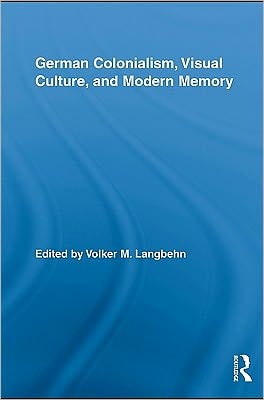
German colonialism, visual culture, and modern memory
0
0
As an Amazon Associate and affiliate partner, Menrva Books earns from qualifying purchases. Learn more
Author Description
There is no overarching master narrative in understanding the history of German colonialism, and over the past decade, the study of Germany’s colonial past has experienced a dramatic transformation in its scope of inquiry. Influenced by new theoretical and methodological approaches to the study of race, nationalism, and globalization, these new studies initiate a process of reevaluating and redefining the parameters within which German Colonialism is understood. The role of visual materials, in particular, is ideal for exploring the porousness of disciplinary boundaries, though visual culture studies pertaining to German history – and especially German colonialism – have previously been almost completely neglected. Investigating visual communication and mass culture, print culture and suggestive racial politics, racial aesthetics, racial politics and early German film, racial continuity and German film, and photography, German Colonialism, Visual Culture, and Modern Memory offers compelling evidence of a German society between 1884 and 1919 that produced vibrant and heterogeneous – and at times contradictory – cultures of colonialism.This collection of new essays illustrates the dramatic changes and vast array of perspectives that have recently emerged in the study of German colonialism. In documenting the latest cutting-edge research of German colonial history, the contributors to this volume prove wrong the persistent assumptions that the creation of Germany’s colonial empire did not have any lasting impact on German political and cultural life. Their essays document how colonialism in its various forms was entwined with the inner workings of modern German life and society, especially through the cultural and technical innovations of its time. In contrast to existing research, these studies show that colonial Germany played a significant role in shaping German perceptions of racial difference, influenced German support for World War I, and facilitated the construction of modern German identity.
Menrva's Summary
THE THESIS
This collection investigates how visual culture and mass media served as critical instruments in shaping German colonial identity and racial politics between 1884 and 1919. Edited by Volker Langbehn, the volume compiles interdisciplinary essays that challenge the notion that Germany's colonial empire lacked a lasting impact on domestic political and cultural life. By applying modern theoretical frameworks to historical artifacts, the contributors argue that colonial ideologies were deeply embedded in the technical and cultural innovations of the era.
THE SCOPE MAP
What You Will Find
- Analysis of visual communication, print culture, and early German film as tools of colonial propaganda.
- Examination of racial aesthetics and the construction of difference within the German public sphere.
- Case studies on the intersection of photography and colonial expansion.
- Research regarding the influence of colonial narratives on German support for World War I.
THE AUTHORITY PERSPECTIVE
Scholars and historians recognize this volume as a significant contribution to the study of German colonial history, particularly for its focus on previously neglected visual media. The text is frequently cited for its academic rigor and its ability to bridge the gap between colonial studies and visual culture theory.
Page Count:
328
Publication Date:
2010-01-01
Publisher:
Routledge
ISBN-10:
0203856902
ISBN-13:
9780203856901
History
Colonialism
German history
Racism
Collective memory
Africa
Germany
Visual Culture
Sociology
Imperialism
Community Tags
Other Editions(4)


Similar Books









Reader Comments
Share Your Thoughts
No comments yet. Be the first to share your thoughts!